

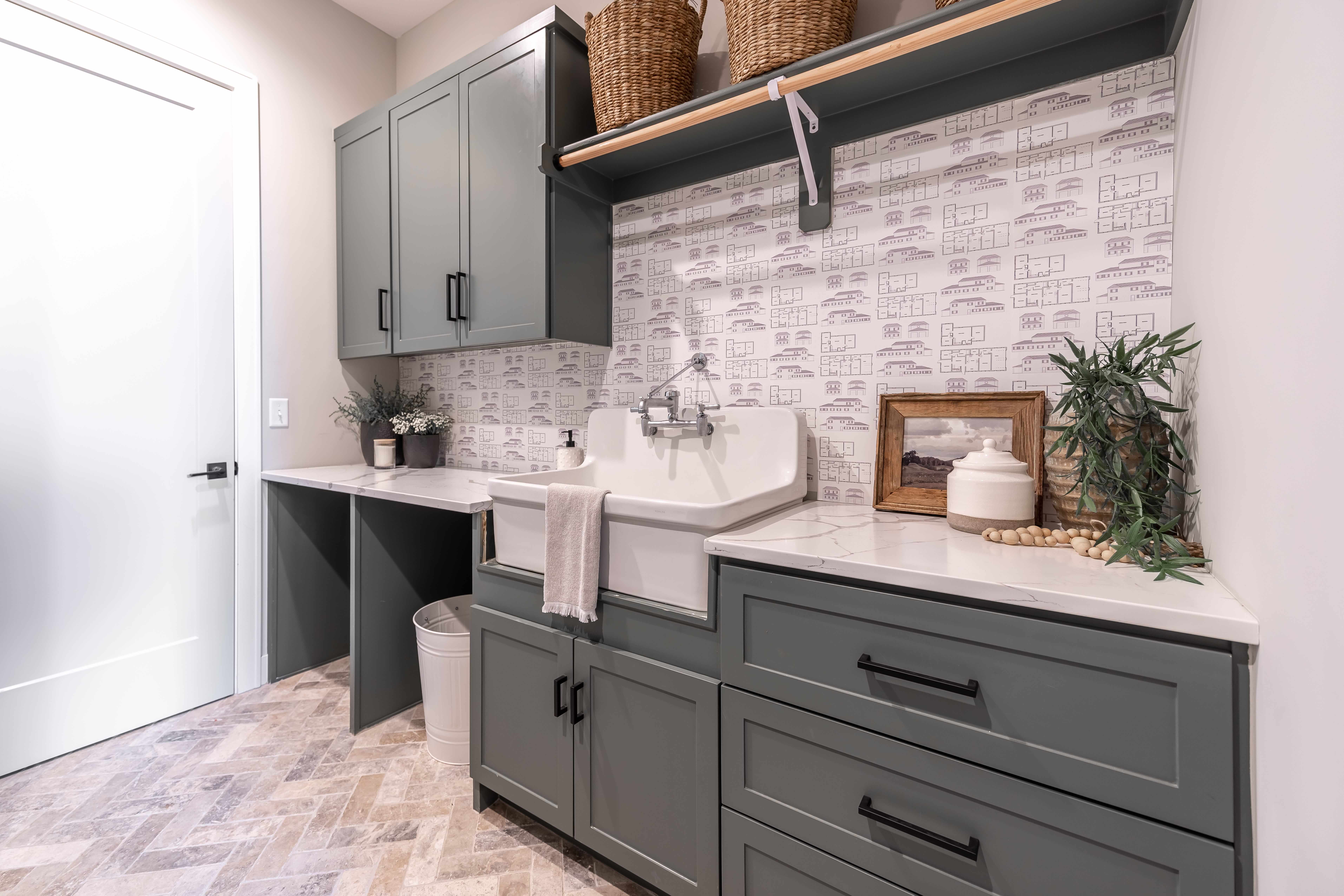
Like death and taxes, laundry is an inevitable part of life. Laundry rooms are typically small spaces that house the washer and dryer along with cabinets and shelving. Some homeowners maximize space even further by adding a sink, a hanging rack, utility cabinets, and additional workspaces.
Understanding the challenges like moisture exposure, frequent use, and limited space will help you design a laundry room that meets your clients' needs. The right laundry room cabinet doors and drawers will offer the right storage and stand up to moisture and daily use. Optimizing the layout creates a space that works for your client, making laundry day easier and more enjoyable.
In this article:
- Planning Your Laundry Room Cabinet Layout
- Laundry Room Cabinet Materials and Construction Options
- Storage Features and Interior Organization Ideas
- Design and Style Considerations
- Installation and Maintenance Best Practices
- Benefits of Custom Cabinet Components in Laundry Rooms
- Budgeting and Cost-Saving Tips
- Final Thoughts on Laundry Room Cabinet Solutions
- Frequently Asked Questions
Planning Your Laundry Room Cabinet Layout
Laundry rooms are notoriously small. Because of this, the laundry room cabinet layout should be customized to fit the available space. Moisture from the washer and dryer can also create a humid environment, which can damage laundry room cabinets. Hardware selection needs to fit with the design while also being incredibly functional.
Assessing Your Client’s Space and Workflow
It’s important to assess the space and your client’s workflow to determine the best cabinet, washer, dryer, and workspace layout. If the space allows, you can suggest installing an island for additional storage and workspace.
Small spaces may require creative solutions. Open shelving works well with base cabinets in small spaces. Smaller laundry rooms may benefit from a taller pantry cabinet to maximize vertical space. You can also suggest types of cabinet doors that make a space feel more open, like slab or shaker style.
Types of Laundry Room Cabinets
There are several types of laundry room cabinets.
- Wall-mounted cabinets hang on the upper part of the wall, making items accessible at eye-level and taking advantage of vertical space.
- Base cabinets are installed on the floor and include a countertop. These large cabinets offer lots of storage space.
- Utility cabinets are taller and often not as wide as standard cabinets, and can include space for mops and brooms as well as shelving and pullout storage options.
- Freestanding storage units and carts offer additional flexibility and can be placed as a temporary solution or moved as needed to support workflow on laundry days.
All of these cabinet options, save the freestanding storage, fall within three categories—stock, semi-custom, and custom.
-
Stock Cabinets: Standard size cabinets that can be found at big box hardware stores. These are the most affordable style but they lack customization options.
-
Semi-Custom Cabinets: These cabinets are based on a stock cabinet but have the option to customize certain features depending on the manufacturer.
-
Custom Cabinets: Customized to meet the client’s size, cabinet door style, hardware, and finish preferences. They’re more expensive than the other styles, but they will achieve your client’s design goals.
Measuring for Cabinet Dimensions and Clearances
After determining the type of cabinets that will best fit the space, it’s time to measure for cabinet dimensions and clearances. Measure the area where the cabinets will be and determine the number of cabinets that will fit based on the desired dimensions. If your client is choosing custom cabinetry, make sure the measurements are accurate and that the cabinets will fit their space and needs.
Deciding Between Upper, Base and Tall Cabinets
The decision to incorporate each of these cabinet types will depend on the available space and laundry room layout. In small spaces, a tall cabinet means that you can maximize the vertical space available and create storage for difficult-to-store items, like mops, brooms, or even a trash can.
Another option for small spaces is to forego upper cabinets in favor of open shelving or a clothes hanging bar, or create a layout that includes all three.
Incorporating Appliances, Sinks and Countertops
A laundry room needs to be functional above all else. Incorporating appliances — the washer and dryer — is nonnegotiable, but you can also consider adding a sink for easier rinsing and stain treatments. You can even include additional storage and allow space for plumbing with a U-shaped drawer under a sink.
If you install base cabinets, you’ll have some countertop that goes along with it, but adding an island or other type of standalone table can increase the amount of workspace available for folding clothes or resting laundry baskets. Clients can also choose to install a countertop or shelving above front-load washers and dryers.
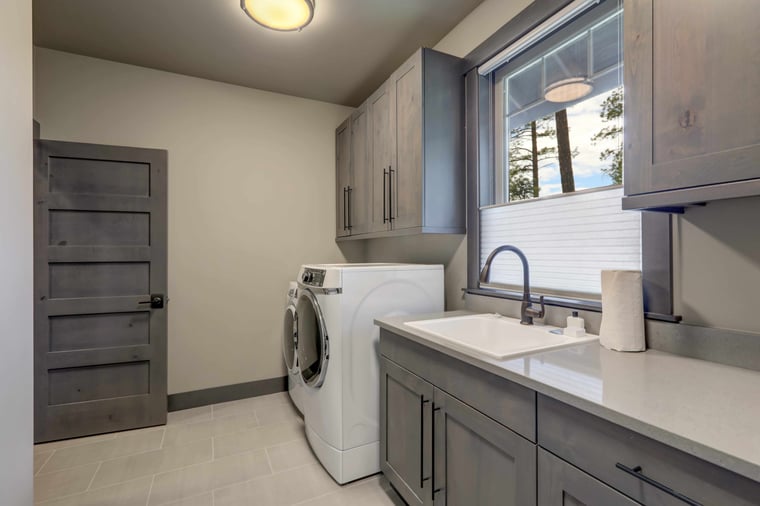
Laundry Room Cabinet Materials and Construction Options
Choosing the right materials and construction options sets the project up for success from the start. Taking the moisture and usage into consideration will help you determine the best material and construction for your client’s space.
Solid Wood, Plywood, MDF and Particleboard
Laundry room cabinetry includes cabinet boxes, doors, drawer boxes, and drawer fronts. Cabinet boxes are often made from plywood or MDF, and then you can choose from these materials or solid hardwood for the drawer boxes, doors and drawer fronts.
- Solid wood. If choosing solid wood for laundry room drawer fronts and cabinet doors, go with a moisture-resistant species like maple. Making sure to use a durable paint and seal the doors and drawer fronts properly will guard against moisture-related issues.
- Plywood. High-quality plywood cabinet doors will stand up well against laundry room moisture, but they also need to be painted and sealed properly.
- MDF. Like plywood, MDF cabinet doors and drawer fronts can work in a laundry room, especially if it’s finished with high-quality paint or stain and sealed well. It is also useful to use moisture-resistant MDF materials.
Regardless of the material you choose, make sure that the surface and edges are sealed properly with moisture-blocking sealants to protect them from the humidity and moisture present in the laundry room.
Other factors, like drawer construction, also impact durability. Hand-assembled dovetail drawer construction, for instance, uses an interlocking joint to provide superior strength in this high-use area. Hand-finished custom cabinet doors offer superior craftsmanship, which increases durability and longevity.
Door Styles and Construction Methods
Cabinet doors are constructed using either one, two, or five pieces:
- Five-piece construction includes a center panel with two rails and two styles.
- A two-piece door is constructed with MDF material and consists of the center panel and an outer frame.
- A one-piece door is made of a single piece of MDF with a routered design or left as a slab.
Edge profiles and framing bead profiles add character and enhance the design.
Hardware, Hinges, Drawer Glides
Laundry room cabinets see a lot of use, especially in busy households. Quality hardware, hinges, and drawer glides extend the life of the cabinetry and make it easier and more enjoyable to use. Hardware plays a big role in shaping the space’s design and ease of use. When choosing hardware, make sure that it fits the client’s design goals and is also easy to grasp.
Soft-close hinges and drawer glides are a great choice because they eliminate the noise that comes with slamming doors and the wear and tear. Drawers and doors will last longer, protecting your client’s investment in their laundry room.
Storage Features and Interior Organization Ideas
Including storage and organizational features helps your client make the most of the laundry room space available. You can add storage in the form of utility cabinets and corner cabinets, and increase organization with specialty drawer inserts. Here are some ideas you can present to your client:
- Drawers, roll-outs, and custom drawer inserts increase organization and keep the space uncluttered.
- Vertical storage, like utility cabinets, hanging rods, and drying racks, maximizes available space.
- Corner drawers provide more space in tight areas.
- Adjustable shelving allows for customized storage.
Design and Style Considerations
Laundry rooms tend to get forgotten in the grand scheme of the home. They’re small, but they play a very important role in daily life, which is why design and style considerations should be at the forefront of the discussion, not an afterthought.
Customization and Finishing Options
Designing the laundry room to fit the house's overall style makes it feel like part of the larger design. As with kitchen and bathroom cabinets, there are lots of customization and finish options to present to your clients.
- Paint versus stain: Cabinets can be painted or stained to meet the client’s vision for the laundry room. Paint offers a wide range of color options while stain brings out the wood’s natural beauty.
- Edge profiles: Edge profile designs embellish the outer edge of the cabinet doors to fit with the space’s design.
- Framing bead profile: Framing bead profiles add detail to the inside profile of the cabinet doors to further the design goals.
- Door position options: The door position relative to the cabinet box (inset vs. overlay) will depend on the client’s preferences.
- Inset doors are installed inside the cabinet to sit flush with the cabinet box.
- Partial overlay doors cover a portion of the face frame when closed and work best with framed cabinets.
- Full overlay doors cover the entire cabinet, whether it’s framed or frameless.
- Hardware: Ornate, detailed hardware works best with traditional designs, while clean and simple options are best for modern designs.
Coordinating Cabinets with Countertops and Flooring
Coordinating cabinets with the countertops and flooring gives the laundry room a finished and cohesive look. For a harmonious design, match the undertones to keep the space feeling intentional. Choose countertops and flooring that bring out the natural undertones of the wood or, if the cabinets are painted, go with colors that complement the cabinets.
Because the laundry room is small, each of these elements is essential to bringing the room together. If the laundry room is near the kitchen or being installed at the same time, the client might want to use the same countertop material as they used in their kitchen. The same is true for flooring. In these cases, work with the existing materials to choose the best cabinet color.
Modern, Traditional and Farmhouse Looks
The laundry room drawer fronts and cabinet doors will ultimately guide the look. There are several design styles to choose from, and each one takes the space in a different design direction. Cabinet choice depends on whether your client wants a modern, traditional, or farmhouse look.
- Shaker: Shaker cabinet doors and drawer fronts offer a modern look with a recessed center panel and a raised frame with clean edges.
- Raised panel: Raised panel cabinet doors add a traditional look to support traditional laundry room designs.
- Flat panel: Another option for modern designs, flat panel cabinet doors and drawer fronts create a smooth and modern look.
- Beadboard: Beadboard cabinets are great for farmhouse and traditional designs, but they’re more difficult to clean because of the grooves.
Cabinet hardware and light fixtures also contribute to the overall design and style. Choosing these elements intentionally brings the whole space together.
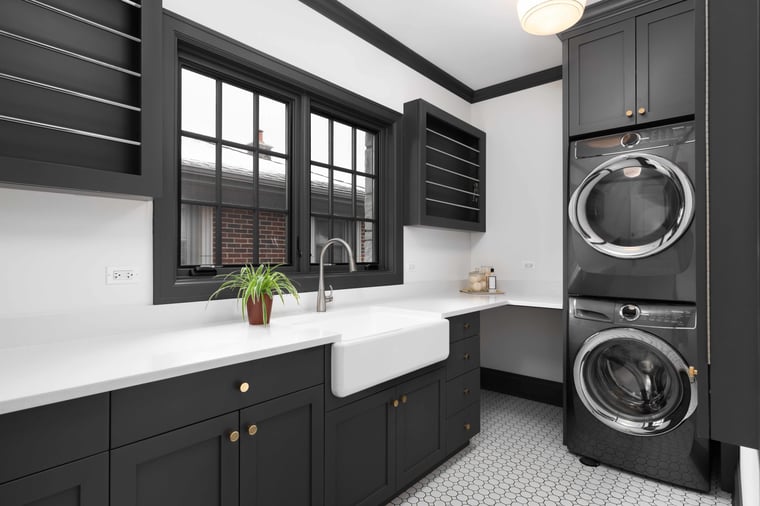
Installation and Maintenance Best Practices
Proper installation and continued maintenance are the best ways to keep the laundry room beautiful and functional.
Installation
After the laundry room design is finalized and the cabinets, doors, and drawers have arrived, it's time to install everything. Installing laundry room cabinets is similar to installing kitchen and bathroom cabinets. But like installing bathroom cabinets, you’ll likely be working in a tight space.
When you install the doors, use your client’s preferred hinges to achieve an inset, overlay, or partial overlay and use the alignment screws to adjust each door so it’s even on all sides. Drawer glides will need to be installed inside the cabinet boxes with the clips installed on the drawer box. These should also be aligned so that the drawer fronts are square with the doors and countertop.
Maintenance, Durability and Longevity
To protect the cabinets, cabinet doors, and drawers from moisture, it’s essential that the laundry room is properly ventilated and that dehumidifiers or fans are used when necessary. You should assess the space to offer recommendations. All cabinets should be wiped down regularly to prevent buildup from laundry supplies and lint. This should be done with a mild detergent and a clean cloth to protect the finish
To prevent damage to the doors and hinges, tighten hinges when necessary and repair any minor damage as it occurs. This means that any chips or scratches should be sanded and then stained or painted and sealed to protect the underlying cabinet material.
If your client is planning any future upgrades, you can design the space to accommodate them when the time comes. This may mean leaving an open space and installing a hanging bar with the knowledge that they might add a cabinet down the road.
Benefits of Custom Cabinet Components in Laundry Rooms
Because laundry rooms are typically small spaces that are used daily, there are lots of advantages to custom cabinet components. Custom designs and cabinets offer storage to reduce clutter, provide workspace for sorting and folding, and create space for custom solutions like built-in hampers and hanging bars. A beautiful and functional laundry room can make laundry more enjoyable and even raise the home’s value.
To make the room even more organized, custom cabinets support tailored storage with custom inserts. Like custom closet drawers that can be designed for each client's specific needs, custom drawer construction for laundry rooms means that your clients get the most out of their small space.
Cabinetry for utility spaces like laundry rooms needs to be durable and able to handle frequent use. Hardwood cabinet doors and hand-finished dovetail drawers offer superior durability in this space. Eagle Woodworking offers reliable lead times between 1 and 2 weeks, so your project can stay on track.
Budgeting and Cost-Saving Tips
Understanding your client’s budget will help you make appropriate recommendations and offer cost-saving tips when appropriate. Stock cabinet cost falls between $100 and $300 per linear foot and are a good choice for clients with tighter budgets. If the client has the budget, custom cabinets are at the higher end of the cost range — between $500 and $1,200 per linear foot — but they offer the most flexibility to meet your client's exact needs. There are additional factors that also impact cost.
Cost Factors That Affect Laundry Cabinet Pricing
Cost factors that affect laundry cabinet pricing include the following:
- Materials: Hardwood, plywood, and MDF fall into different cost ranges
- Style and type: More detailed cabinet styles, including the framing bead and edge profiles, will cost more while simple cabinets will fall on the lower end of the price range.
- Size: Larger cabinets will cost more, so keeping this in mind as your client plans will help them say within their budget.
- Hardware: Cabinet hardware cost ranges from $1 to over $50 per piece, which provides some wiggle room. Choosing less expensive hardware can free up space in the budget for other things, but clients may also want to splurge on high-quality hardware.
- Installation: Clients should be aware of the installation cost, so they can account for it in their laundry room budget.
Refacing, Repainting, and Updating Existing Cabinets
If the laundry room’s existing cabinets are in good shape but need an updated look, there are a few options to consider. Refacing the cabinets means removing the existing doors and replacing them with new ones. Cabinet doors and drawer fronts can also be repainted as a way to update them.
Refacing is an excellent choice and even delivers a high ROI for the fraction of the cost it would take to replace the cabinets entirely—typically 30-50% of a full cabinet replacement. Repainting cabinets and cabinet doors is also an option, but while it’s less expensive than replacing the cabinets entirely, it’s a labor-intensive process.
Final Thoughts on Laundry Room Cabinet Solutions
Laundry room cabinets provide the storage needed to keep the space organized and functional. Plus, they offer lots of options to guide the aesthetics of the space. Because of the moisture that naturally comes with laundry rooms, choosing high-quality materials is essential for maintaining a beautiful space over time. High-quality craftsmanship is essential to building long-lasting cabinets that can stand up to frequent use and provide the storage necessary.
Eagle Woodworking’s fast and predictable lead time keeps your project on schedule and offers premium components and service. We offer custom dovetail drawers and cabinet doors for the trades — easy to order, built to spec, and delivered fast.

Frequently Asked Questions
What are the standard sizes for laundry room cabinets?
Standard size laundry room base cabinets are typically 24 inches deep and 34.5 inches high. Standard widths range from 9 inches to 48 inches. Wall cabinets are 12 inches deep and between 24 and 42 inches high. Pantry or utility cabinets can be either 12 or 24 inches deep and between 84 to 96 inches high. If these dimensions don’t work, custom cabinets can be constructed to meet any dimension requirements.
What materials offer the best moisture resistance for laundry cabinets?
Solid hardwood, plywood, and MDF all work well to resist moisture in laundry rooms. That said, they will need to be properly painted or stained, then sealed to protect against heat and humidity. To maintain their look and quality, they should be cleaned regularly, and the room should be properly ventilated.
Can I match laundry room doors to my kitchen cabinets?
To match your laundry room doors to your kitchen cabinets, make note of the edge and framing bead profiles. You can also choose the same finish and coordinating hardware to keep the design consistent.
What is the cost difference between standard and custom doors?
Refacing cabinets with custom doors for a smaller project, like a laundry room or small kitchen, costs as little as $5,000. While the client will likely pay more for custom doors than they would for stock doors or stock cabinets, the high-quality craftsmanship and materials improve longevity and durability, making the custom route a viable choice.