

Accurate measurements are essential when ordering custom cabinet doors and drawer fronts. This guide walks you through the most common measuring methods for overlay and inset cabinet doors, whether you're replacing existing doors or measuring cabinet openings for new installations. Step-by-step instructions, formulas, and worked examples will help you determine the correct door sizes before placing your order.
In this guide:
- The Difference Between Inset and Overlay Cabinet Doors
- Measuring Overlay Cabinet Doors
- Measuring Inset Cabinet Doors
- Cabinet Measuring FAQ
The Difference Between Inset and Overlay Cabinet Doors
Before measuring, identify whether your cabinets use an overlay or inset design. Overlay cabinet doors extend past the cabinet opening, while inset cabinet doors sit flush within the opening. Because each uses a different sizing method, it's important to identify your cabinet type before taking measurements.
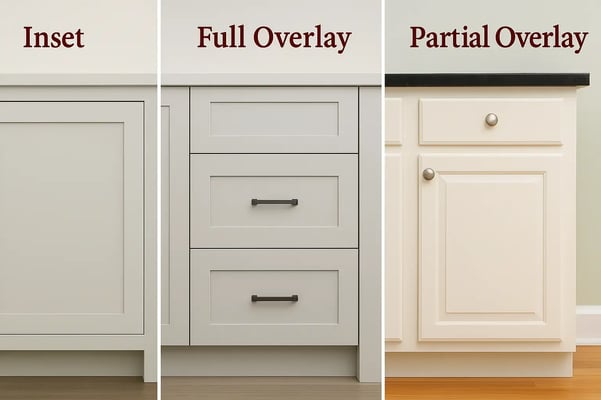
Cabinet Door Overlay
Cabinet door overlay is the distance a cabinet door extends past the cabinet opening. The overlay determines the finished door size and helps determine the appropriate hinge configuration.
- Partial Overlay: Typically use a 1/2" overlay, leaving about 1" of the face frame exposed around doors and drawer fronts. This configuration commonly uses a 1/2" concealed overlay hinge.
- Full Overlay: Typically use a 1-1/4" overlay, leaving about 1/4" of the face frame exposed. This configuration is commonly paired with a 1-1/4" concealed overlay hinge.
Inset Cabinet Doors
Inset cabinet doors sit flush within the cabinet opening rather than extending past it. Because there is no overlay, inset cabinet doors are measured directly from the cabinet opening, allowing for the required clearance (1/8″ gap around all sides).
Measuring Overlay Cabinet Doors & Drawer Fronts
Step 1: Identify Your Overlay Type
Partial Overlay (Using 1/2" Overlay)
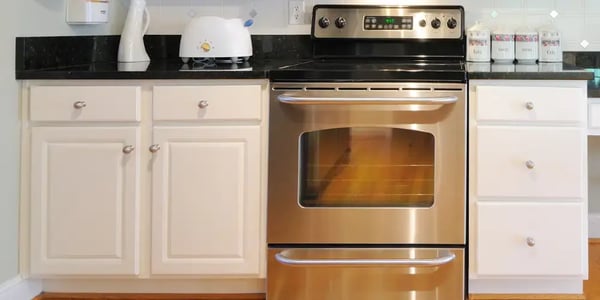
- Appearance: Leaves about 1" of the face frame exposed around doors and drawers.
- Hinge Needed: 1/2" concealed overlay hinge.
Full Overlay (Using 1-1/4" Overlay)
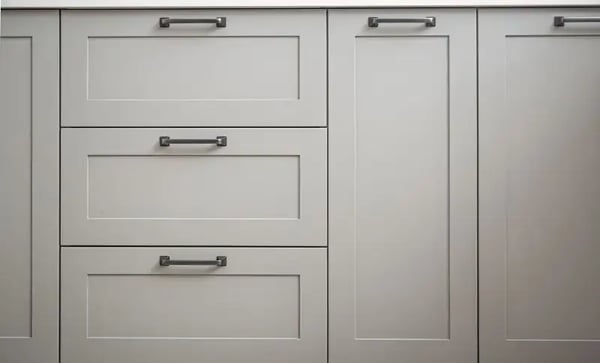
- Appearance: Leaves about 1/4" of the face frame exposed.
- Hinge Needed: 1-1/4" concealed overlay hinge.
|
Not sure what overlay your cabinets use? If you're replacing existing cabinet doors and aren't sure what overlay your cabinets use, measure the existing overlay before calculating your new door size.
|
Step 2: Choose Your Measuring Method
Decide whether you'll measure the existing cabinet doors or the cabinet openings. The correct method depends on your project and whether you're keeping the existing overlay and hinge configuration.
|
Best if:
|
Best if:
|
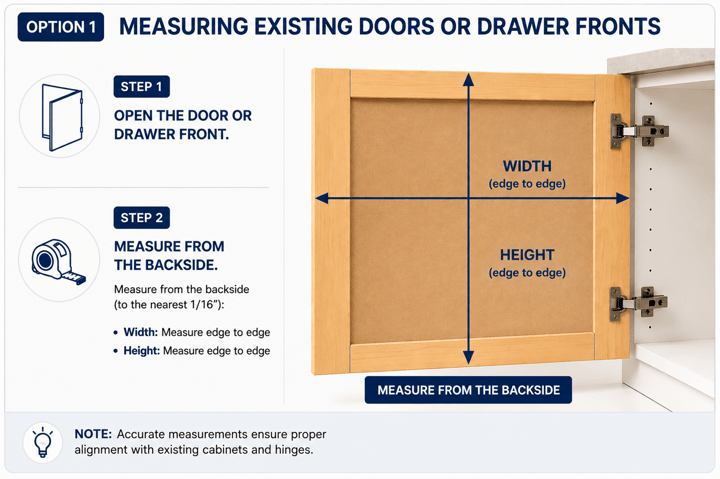
Option 1: Measuring Existing Doors or Drawer Fronts:
Step 1. Open the cabinet door or drawer front.
Step 2. Measure from the backside (to the nearest 1/16"):
- Width: Measure edge to edge
- Height: Measure edge to edge
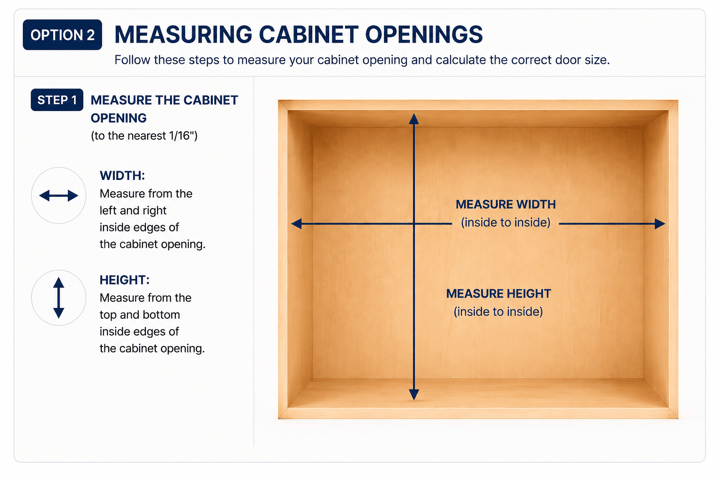
Option 2: Measuring Cabinet Openings
Step 1: Measure the Cabinet Opening (to the nearest 1/16”)
- Width: Measure from the left and right inside edges of the cabinet opening.
- Height: Measure from the top and bottom inside edges of the cabinet opening.
Step 2: Calculate Finished Door Size with Overlay
- For Partial Overlay (1/2"):
- Add 1" to both width and height (1/2" overlay on each side).
- For Full Overlay (1-1/4"):
- Add 2-1/2" to both width and height (1-1/4" overlay on each side).
|
For a single door, the door’s width and height will be the width or height of your opening plus twice the overlay:
For split (or double) doors—2 doors on 1 opening—the overlay is only on the edges facing the frame. The doors are separated by the center reveal which is typically 1/8". To calculate your door width take the opening plus twice the overlay, subtract .1/8“ (for the reveal), and divide by 2. The height is the same as with a single door.
|
Use the worked examples below to calculate the finished door size for your selected overlay.
Example Calculations for Overlay Doors
|
Overlay Type |
Door Configuration |
Cabinet Opening |
Finished Door Size |
|
Partial Overlay (1/2") |
Single Door |
15" W × 27" H |
Door Width: 15" + (1/2" x 2) = 16" Door Height: 27" + (1/2" x 2) = 28" |
|
Partial Overlay (1/2") |
Split Doors |
30" W × 27" H |
Door Widths: (30" + (1/2" x 2) - 1/8") / 2 = 15-7/16" Door Heights: 27" + (1/2" x 2) = 28" |
|
Full Overlay (1-1/4") |
Single Door |
12" W × 24" H |
Door Width: 12" + (1-1/4" x 2) = 14-1/2" Door Height: 24" + (1-1/4" x 2) = 26-1/2" |
|
Full Overlay (1-1/4") |
Split Doors |
30" W × 24" H |
Door Widths: (30" + (1-1/4" x 2) - 1/8") / 2 = 16-3/16" Door Heights: 24" + (1-1/4" x 2) = 26-1/2" |
Additional Tips for Measuring Overlay Doors
- Customize Overlay: Adjust calculations if you prefer a different overlay size.
- Applicable to Drawer Fronts: Use the same instructions for measuring drawer fronts.
- Precision Matters: Always measure to the nearest 1/16".
- Double-Check Measurements: Ensure all measurements are accurate for a perfect fit.
Measuring Inset Cabinet Doors & Drawer Fronts
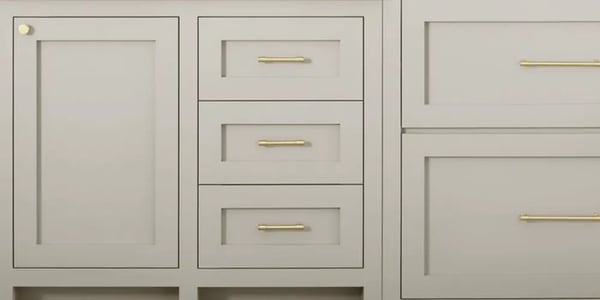
Inset cabinet doors are designed to sit flush within the cabinet frame opening, so no overlay calculation is required. Instead, measure the cabinet opening and subtract the required clearance to determine the finished door size.
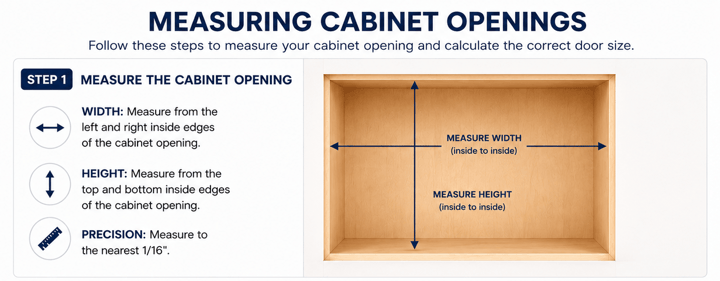
Step 1: Measure the Cabinet Opening
- Width: Measure the inside width of the cabinet opening from the left inside edge to the right inside edge.
- Height: Measure the inside height from the top inside edge to the bottom inside edge.
- Record each measurement to the nearest 1/16"
Step 2: Subtract the Required Clearance
To allow for a 1/8" gap on all sides of the door, ensuring proper clearance and operation:
- Subtract 1/4" from the total width measurement (1/8" for each side).
- Door Width = Opening Width − 1/4"
- Subtract 1/4" from the total height measurement (1/8" for each side).
- Door Height = Opening Height − 1/4"
Example Calculation for Inset Doors
- Cabinet Opening Measurement:
- Width: 16"
- Height: 34"
- Calculation:
- Door Width: 16" (opening width) − (1/8" x 2) = 15 3/4"
- Door Height: 34" (opening height) − (1/8" x 2) = 33 3/4"
- Result:
- Inset Cabinet Door Size: 15-3/4" Width x 33-3/4" Height