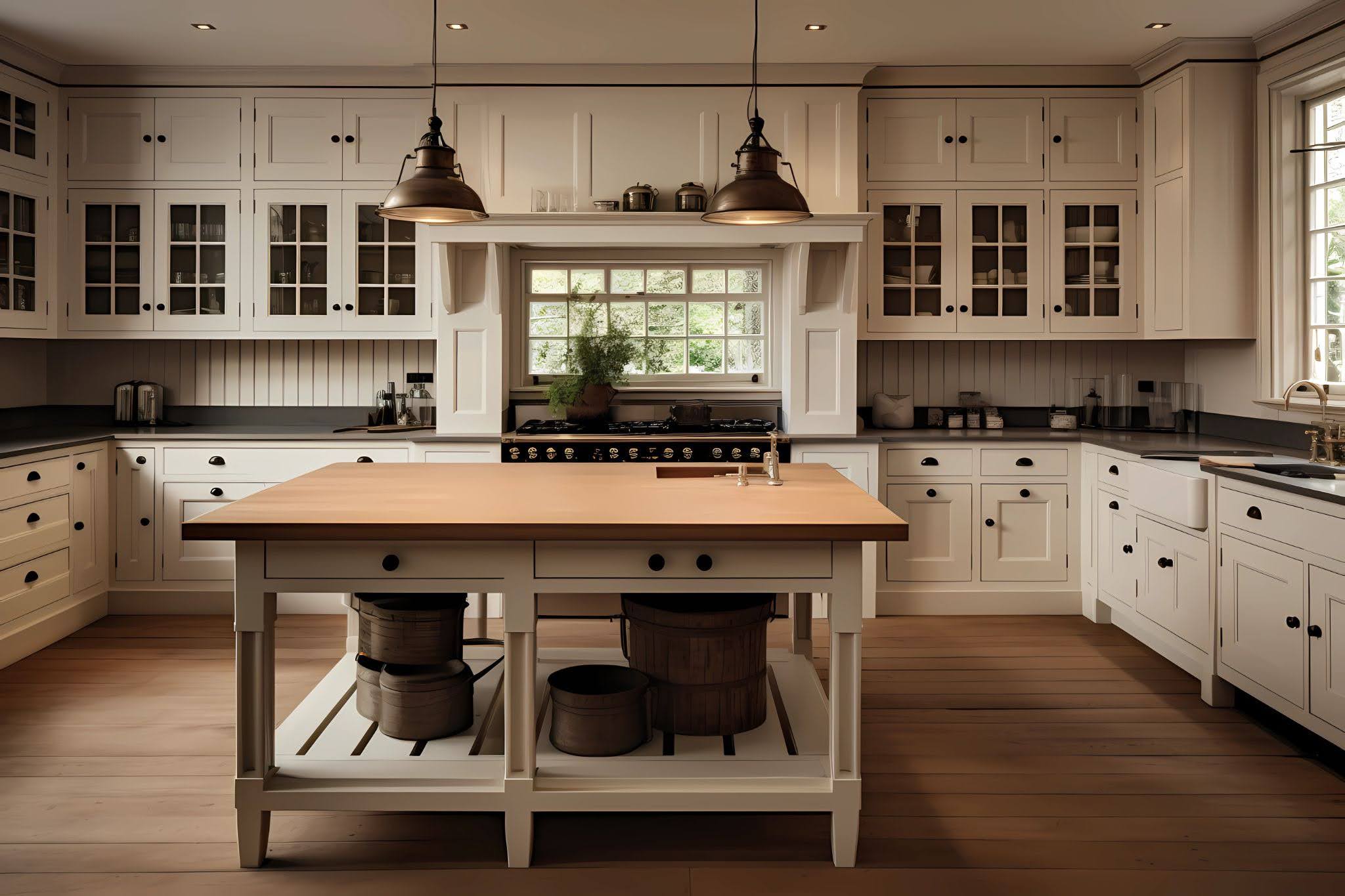
For modern cabinet projects, flat panel cabinet doors provide clean lines and a consistent, easy-to-finish surface. They work across full kitchen installations, bathrooms, refacing projects, and built-ins, offering a streamlined look without adding complexity to manufacturing, finishing, or installation.
They are a reliable choice for cabinetmakers and contractors who need durable, straightforward construction and predictable results. Designed for both new builds and replacement projects, they support efficient installation and dependable lead times.
This guide covers flat panel cabinet door construction, material options, and where they make the most sense in real-world builds—so you can choose the right door style based on project scope, finish requirements, and install conditions.
In this article:
- What Are Flat Panel Cabinet Doors?
- Materials and Finishes for Flat Panel Cabinet Doors
- How to Choose Flat Panel Cabinet Doors
- Installation and Performance Considerations
- Final Considerations for Flat Panel Cabinet Doors
- Frequently Asked Questions
What Are Flat Panel Cabinet Doors?
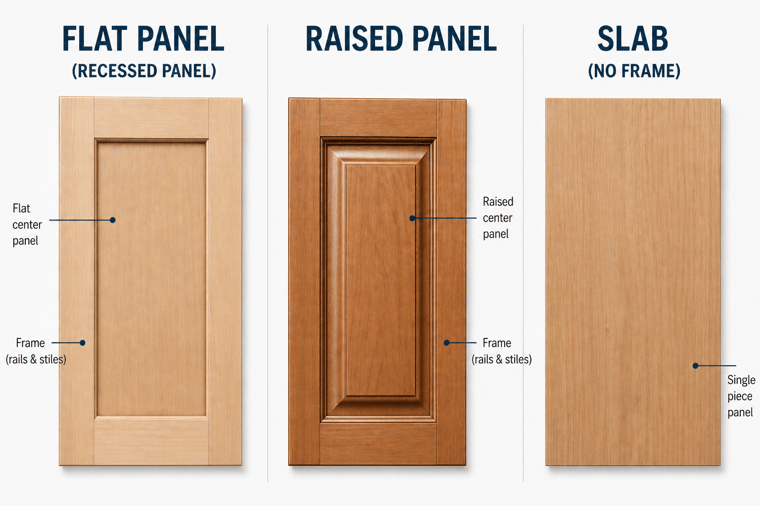
Flat panel cabinet doors (also called recessed panel doors) feature a flat center panel set within a frame constructed of rails and stiles. The center panel sits recessed or flush, without ornamental profiles, creating a clean and consistent surface.
Key Characteristics
- Available in multiple construction types – including 5-piece frame-and-panel (rails and stiles surrounding a flat center panel) as well as 1-piece or 2-piece MDF options
- Allows for wood movement – floating panel design helps prevent warping over time
- Clean, low-profile surface – no raised detailing or heavy profiles
- Consistent across runs – supports repeatable sizing and efficient installation
Quick Spec Overview
- Construction: 5-piece frame (rails and stiles) with a flat center panel; 1-piece or 2-piece MDF construction
- Common style: Shaker (flat panel with a square frame profile)
- Best for painted: MDF or MDF center panel construction
- Best for stain-grade: Solid wood or wood veneer
Flat panel doors are commonly used across full cabinet builds, refacing projects, and high-volume installs where consistency and clean execution matter.
Flat vs. Raised vs. Slab Cabinet Doors
Flat panel, raised panel, and slab doors each use different construction methods, which directly impact how they perform on the jobsite and where they’re best used.
- Flat Panel (recessed panel) doors use a 5-piece frame-and-panel construction with a flat center panel, making it a versatile option for both paint-grade and stain-grade projects. This category includes Shaker-style cabinet doors, which are simply flat panel doors with a specific frame profile.
- Raised panel doors also use a 5-piece construction, but the center panel is machined with a profile, adding depth and detail typically suited for more traditional cabinetry.
- Slab doors are built as a single piece with no frame or center panel, creating a continuous surface. This simplifies manufacturing but requires more precision during installation and relies heavily on material stability, especially on larger doors.
Each style serves a different purpose, but flat panel doors—especially Shaker—are the most widely used across modern, transitional, and large cabinet builds due to their balance of simplicity, durability, and flexibility.
Materials and Finishes for Flat Panel Cabinet Doors
Material and finish selection directly impact performance, durability, and consistency across a cabinet run. Choosing the right combination helps reduce movement issues, improve finish quality, and keep installs predictable.
Wood Veneer Flat Panel Doors
Veneer, which uses a real wood layer over an MDF or plywood core, offers a stain-grade look with improved stability. This material is the standard for stain-grade flat panel cabinet doors, offering the same appearance as solid wood with greater durability, improved stability, and a lower overall cost. Species like maple, white oak, walnut, and cherry are commonly used depending on the project requirements.
Solid wood center panels are generally not recommended for flat panel doors, as they are more prone to warping and cracking over time.
MDF (Medium-Density Fiberboard)
MDF is widely used for flat panel cabinet doors due to its durability, stability, and cost efficiency. It provides a smooth, consistent surface for painted applications and is less prone to warping or cracking than solid wood, helping maintain tight reveals and consistent sizing across larger runs..
- MDF center panels with hardwood frames (rails and stiles) are common for painted 5-piece doors
- 1-piece or 2-piece MDF doors offer a durable, cost-effective solution for high-volume or paint-grade projects
Laminate and Thermofoil
Laminate and thermofoil doors are manufactured using engineered substrates—typically MDF—that are fully wrapped or bonded with synthetic surfaces.
- Thermofoil — heat-formed vinyl film vacuum-pressed over an MDF core, creating a seamless, uniform finish; performs well in low- to moderate-use areas but can be sensitive to heat exposure
- Laminate — pressure-bonded surface over an engineered core; high-pressure laminate (HPL) offers strong scratch resistance, better heat resistance, and durability for high-use or high-traffic areas
Both options are available in a wide range of colors and finishes, including high-gloss and wood-grain looks.
They are commonly used in commercial or multi-unit builds where consistency and durability are priorities, but are more difficult to repair if damaged.
Painted vs. Stained Finishes
Finish selection should align with both material and jobsite conditions.
- Painted finishes are best suited for MDF or paint-grade hardwood frames with MDF center panels, delivering a smooth, uniform surface. They require more prep and can show wear over time but provide consistent results across large runs.
- Stained finishes are used on hardwood or hardwood frames with veneer center panels to highlight natural grain. They tend to hide wear better and offer easier long-term maintenance, though material variation will be visible across doors.
Matching the finish to the material—and the environment—helps reduce callbacks and maintain long-term performance, especially in high-use or moisture-prone areas.
How to Choose Flat Panel Cabinet Doors
Flat panel cabinet doors are commonly selected for projects that require consistency, clean lines, and efficient installation. Their simple construction and low-profile design make them a practical choice across a range of cabinet applications.
Popular Use Cases
Flat panel cabinet doors are widely used across several cabinet styles due to their versatility and clean profile.
They are commonly specified for:
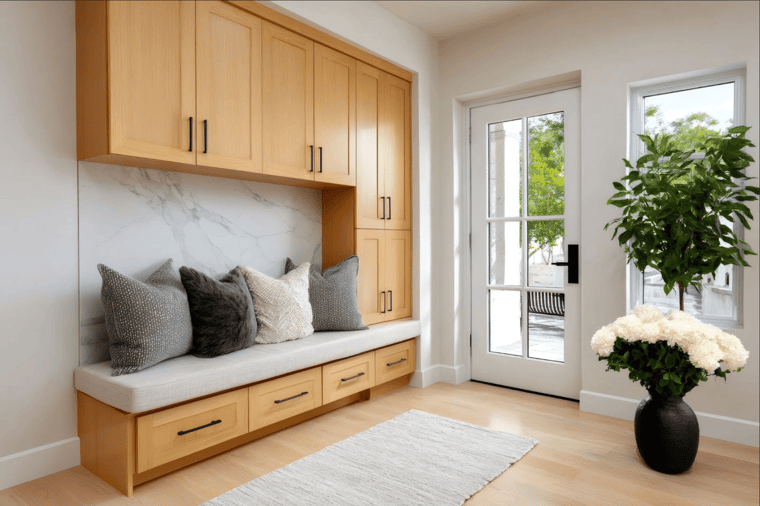
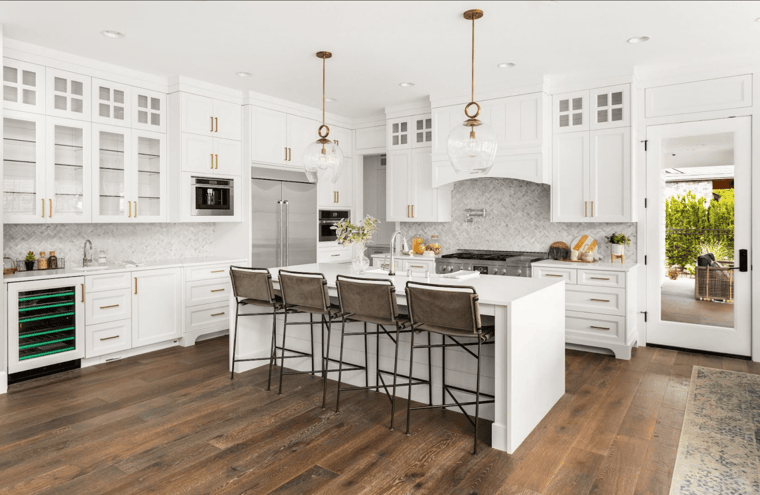
- Modern and transitional kitchens with full overlay cabinet systems
- Pantries and tall cabinet runs where consistent lines are critical
- Bathrooms, mudrooms, and laundry rooms where easy-to-clean surfaces and durability matter
- Commercial and multi-unit builds that require repeatable sizing and efficient installation
Material and Finish Selection
Material and finish selection for flat panel cabinet doors should align with durability, finish requirements, and jobsite conditions.
- MDF is best suited for painted doors, high-volume projects, and cost-sensitive applications; provides a smooth, consistent surface and is less prone to warping or cracking than solid wood
- Wood veneer is the standard for a natural wood look; offers the same appearance as solid wood with better stability and lower cost
Environment also plays a role. Kitchens typically require a balance between appearance and durability, while bathrooms and mudrooms often prioritize cost-effective, moisture-resistant materials like MDF where simpler designs are acceptable.
Style and Hardware
Shaker-style doors, featuring a flat center panel and square frame profile, are the most common flat panel cabinet door style. Other options include variations in rail and stile width, eased or beveled inside edges for subtle detail, and more decorative frame profiles (such as ogee or stepped designs) for more traditional applications. Beveled edge profiles can also function as integrated pulls, reducing hardware requirements but requiring planning during fabrication and install.
Cabinet hardware impacts both appearance and installation. Standard pulls and knobs are the simplest to install and adjust, while edge pulls and integrated profiles maintain a low-profile look but require more precise layout and planning. Push-to-open systems eliminate visible hardware but depend on accurate alignment and consistent door sizing to function properly.
Installation and Performance Considerations
Flat panel cabinet doors are designed for consistency and efficient installation, but their minimal profile requires precision to achieve clean results across the cabinet run.
- Accurate sizing and overlay – Doors must be ordered to the correct overlay or inset spec to maintain consistent reveals and avoid binding. Follow proper measuring guidelines to reduce errors and reorders (see our cabinet door measuring instructions).
- Hinge boring consistency – Proper hinge placement reduces adjustment time and ensures smooth operation. Understanding hinge specs and placement upfront helps streamline installation (see our guide on how to measure cabinet hinges).
- Reveal alignment – Even gaps between doors and drawer fronts are critical for a clean, professional finish.
- Cabinet box accuracy – Out-of-square or uneven boxes are more noticeable with flat panel doors, especially in full overlay installs.
- Clean look requires tighter tolerances – Minimal detailing means alignment issues and inconsistencies are more visible.
- Efficient to install across runs – Consistent construction supports repeatable installs and predictable timelines
- Finish impacts durability – Painted surfaces show wear more easily, making material and finish selection important in high-use areas
Using durable build-to-spec cabinet doors helps reduce adjustments, minimize callbacks, and keep projects moving on schedule. Consistent sizing and reliable lead times make installation faster and more predictable across both small jobs and full cabinet runs.
For projects that include drawer components, accurate sizing is just as critical—reference our dovetail drawer measuring instructions to ensure a proper fit.
Final Considerations for Flat Panel Cabinet Doors
Flat panel cabinet doors offer a practical balance of clean design, durable construction, and installation efficiency. Their simple frame-and-panel build supports consistent sizing, predictable installs, and flexibility across a wide range of cabinet applications, from kitchens and pantries to bathrooms and built-ins.
When specified correctly, material selection, sizing accuracy, and hardware planning all contribute to better alignment, fewer adjustments, and reduced callbacks on the jobsite.
For contractors and cabinet shops, the advantage comes down to consistency and reliability. Build-to-spec flat panel cabinet doors with dependable lead times make it easier to complete projects efficiently and maintain quality across every install.
Order flat panel cabinet doors built to your exact specifications with Eagle Woodworking. Get consistent sizing, fast lead times, and straightforward online ordering to keep your projects moving without delays.
Frequently Asked Questions
How do I measure for flat panel cabinet doors?
Measuring for flat panel doors requires accuracy and proper allowances to ensure proper fit and function. First determine the door position, either inset or overlay. Next measure the height and width of the cabinet opening to the nearest 1/16”. Calculate the appropriate overlay and add two times that measurement to the height and width. For inset doors, subtract ¼” from the width and height to allow for a ⅛” gap on all sides.
What is the difference between MDF and solid wood panels?
MDF is an engineered wood product made from wood fibers and resin, pressed under heat to create a dense, stable panel. Solid wood panels are made from natural lumber and are typically more expensive.
When it comes to flat panel cabinet doors, engineered materials like MDF are typically preferred for their stability, durability, and cost efficiency, as they minimize movement, hold tight reveals, and deliver more consistent results during finishing and installation.
Can I paint or stain flat panel doors?
You can paint MDF flat panel doors and paint or stain solid wood flat panel doors. Surface preparation and finishing methods will vary by material, but typically include sanding, priming (for paint), and applying a protective topcoat. For production work, most doors are factory-finished to ensure consistency and durability.
What lead times should I expect for custom flat panel doors?
Eagle Woodworking offers dependable 2 week lead times for custom flat panel doors orders. We stock a range of hardwoods and can source different materials depending on project needs. Specialty materials or custom requirements may impact delivery timelines.
What hinge types work best with flat panel cabinet doors?
Concealed soft-close hinges are most commonly used with flat panel cabinet doors because they allow for multi-directional adjustment, making it easier to achieve consistent reveals across cabinet runs.
Are flat panel cabinet doors good for refacing projects?
Yes, flat panel cabinet doors are a strong choice for cabinet refacing because their clean profile works well with existing cabinet boxes. Their consistent construction and flexible sizing make it easier to match new doors and drawer fronts to existing layouts, helping streamline installation and maintain a uniform appearance.