

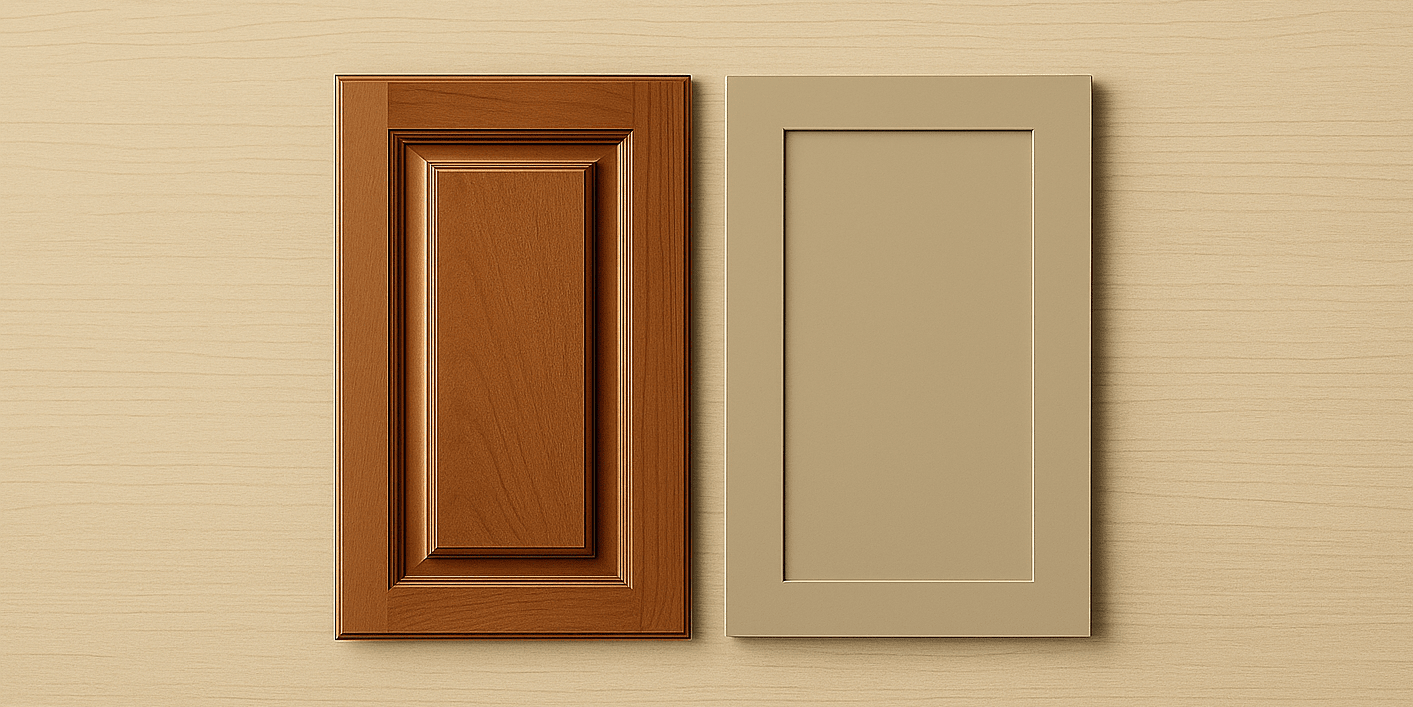
When a client asks for "Shaker" or "raised panel," you need to explain the visible difference and then turn it into a door specification that arrives built the way everyone pictured it. The conventional contrast is simple: a plain frame around a recessed flat center versus a frame around a center panel with a raised, shaped field. Construction, material, and finish are three more decisions, and the profile name settles none of them.
In this article:
- Shaker vs. raised panel cabinet doors at a glance
- What is a Shaker-style cabinet door?
- What is a raised-panel cabinet door?
- Expert Eagle Insight
- Choose the construction and finish with the profile
- Compare cleaning needs without overstating durability
- Confirm the specification before the order
- Choose the profile, then confirm the complete door specification
- Frequently asked questions
Shaker vs. Raised Panel Cabinet Doors at a Glance
Two of the six rows below describe what the client can see; the other four decide how the door gets built and ordered.
|
|
Shaker |
Raised panel |
|
Center-panel shape |
Flat panel recessed behind the frame face |
Panel with a raised center field and a shaped transition at the edges |
|
Frame and profile detail |
Plain, square inside edge on the frame |
Frame often carries an inside profile; the raised center adds its own profile |
|
Common visual associations |
Modern, transitional, restrained |
Traditional, formal, more detailed |
|
Construction and material choices |
Hardwood frame with a flat MDF, veneer, or solid-wood panel; also built as one-piece or two-piece MDF |
Hardwood frame with a raised MDF or solid-wood panel; also built as two-piece MDF |
|
Cleaning considerations |
Fewer contours; the frame-to-panel step still collects dust |
More contours around the raised field and at the frame transition |
|
Decisions to confirm before ordering |
Frame widths, panel material, finish responsibility, size and fit, hardware prep |
Same list, plus the raised-panel profile and how it looks on the smallest fronts |
Those are the conventional forms. Plenty of suppliers, including us, let you mix a plain frame with a raised center or pair a profiled frame with a flat center, so treat the names as a starting point and confirm the actual components before anything goes into production.
What Is a Shaker-Style Cabinet Door?
A Shaker door has a flat frame with a square inside edge surrounding a recessed flat center panel. What you see is the shadow line where the panel steps back from the frame, with no bead or shaped field to compete with it.
The frame is made of rails and stiles. Rails run horizontally across the top and bottom. Stiles run vertically on each side. In a 5-piece door, those four frame members surround a separate center panel, which gives you the five pieces. Appearance and construction are separate, though: a door can have the Shaker look and still be cut from a single piece of MDF, or built from two MDF pieces glued together.
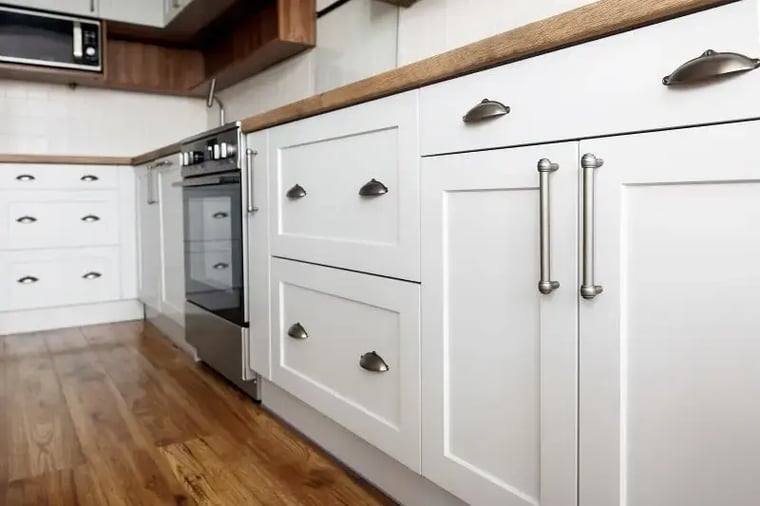
A Shaker door: square inside edge on the frame, flat recessed center panel.
Two terms cause trouble on jobsites. "Recessed panel" describes any framed door where the center sits back from the frame face, and Shaker is the plainest treatment of that idea; other recessed-panel doors carry a bead or bevel on the inside edge. "Flat panel" gets used for both recessed-panel doors and slab doors, and a slab has no frame at all. Tell the supplier the physical form you want, framed with a recessed flat panel or a slab, rather than the label.
With so little detail on a Shaker door, small differences in frame width, panel depth, and finish show up clearly. Compare a few configurations rather than picking from the name alone; our Shaker door options page shows how frame widths and panel choices change the look.
What Is a Raised-Panel Cabinet Door?
A raised-panel door uses the same rails-and-stiles frame, but the center panel has a raised field in the middle with a shaped transition down to the edges that sit in the frame groove. That transition can be a bevel, a cove, an ogee, or a stepped shelf, and it's what gives the door its depth and shadow lines. On many doors the raised field sits flush with or slightly below the frame face; it doesn't need to stand proud of the door to read as raised.
The extra detail is why raised-panel doors read as traditional or formal, and why they need more care in selection. A raised profile that looks right at 15 inches wide can look crowded on a 6-inch drawer front, and a profile that matches the room's trim can look busy against a plain backsplash. Pull an actual sample, set it next to the existing millwork under the room's lighting, and let the client react to that instead of a catalog photo.

A raised-panel door: raised center field with a shaped transition into the frame.
The frame profile and the center-panel profile are separate choices. A raised center can sit inside a frame with a plain square inside edge, or inside a frame with a bead or bevel. For example, our Boston Shaker is named for its square-edge frame, and you can order it with a flat center or a raised center without changing the style name. The raised version keeps the Shaker frame and gains a shaped field in the middle. (Our slim Bar Harbor frame is flat-center only, so this doesn't apply to every style.) Other suppliers group things differently, so specify the frame and the center as two separate items whatever name the catalog uses.
Raised panels are a good fit when the project already has profiled trim, when the client wants visible craftsmanship, or when the doors need to sit alongside existing cabinetry with the same detail. You can compare profiles on our raised-panel door options page.
Expert Eagle Insight
The gap we see most on these jobs isn't between Shaker and raised panel - it's between the name and the picture. A contractor relays "Shaker" from the client, orders a correct Shaker door, and the client meant the kitchen from a magazine photo: different frame width, different edge, different shadow line. All of that was technically Shaker. So don't let the style name close the conversation - put the actual configurations in front of the client instead. Frame width, center panel, and edge profile are each separate selections on our order form, and our style pages show how those choices change the look. Walk the client through the specific combination, get sign-off on the components rather than the label, and read them back on the quote. The jobs that go wrong at delivery are almost never wrong against the order - they're wrong against the picture in someone's head.
On small fronts, don't assume the profile scales. A frame-and-panel look needs room to be a frame and a panel, so on our narrowest fronts the rail and stile widths reduce, and below that the front builds as a slab. Check your smallest front against the style before approving the profile for the whole job, and if it lands in slab territory, show the client - a run that mixes framed doors and slab fronts is common and looks fine, but only when nobody's surprised by it.
Choose the Construction and Finish with the Profile
A style name describes the door's face. Material, construction, and finishing responsibility are separate line items, and skipping one is how a job ends up with the right profile on the wrong door.
Start with the finish, because it drives the rest. A painted door and a stained door call for different substrates. For paint-grade work, an MDF center panel is a common choice because it takes paint evenly and hides no grain. For stain-grade work, you want a veneer flat panel or a solid-wood panel that matches the frame species. Raised panels in solid wood show the grain across the shaped field, which is the point on a stain job; for paint, an MDF raised panel gives you the same profile without the grain.
Then confirm the construction:
- 5-piece wood: a hardwood frame around a separate center panel, which can be MDF, veneer, or solid wood.
- 2-piece MDF: a one-piece MDF frame glued to a separate MDF center panel. Raised centers are available here.
- 1-piece MDF: the whole door machined from a single MDF blank, flat centers only.
Two doors with the same profile can come from any of these, and the weight, the finishing behavior, and the quote all differ. Ask for the construction by name.
Durability comes from the material, the construction, and the finish rather than the profile. Wood products, including MDF, change dimension with moisture, and the Composite Panel Association's guidance on dimensional stability says the design has to account for that movement. Frame-and-panel construction exists partly for that reason: the panel floats in the frame groove so seasonal movement has somewhere to go. That applies to a flat panel and a raised panel alike.
Finally, settle who finishes the door. Some suppliers deliver finished doors. Others deliver unfinished or primed doors and leave the topcoat to you or a finisher. For example, when you order from us, doors ship unfinished by default with optional priming, and painting or staining happens at your shop or your finisher's. Put that in the quote and the client conversation so nobody expects a finished door that isn't part of the order.
Compare Cleaning Needs Without Overstating Durability
Both doors have a step where the frame meets the panel, and that step collects dust and grease in a kitchen. On a Shaker door, that's the main contour. On a raised-panel door, add the shaped transition around the raised field, which means a few more surface changes to wipe around.
What actually determines cleaning and wear is the finish. A conversion varnish, a waterborne lacquer, and a wiped oil behave differently under a damp cloth and under a degreaser, and each has a cure window before it should be cleaned at all. General Finishes publishes finish-specific care instructions for its own products that illustrate the pattern: wait for full cure, use a water-damp cloth for routine cleaning, and avoid oil-soap or silicone cleaners that can interfere with a later recoat. Those directions cover that manufacturer's finishes; whatever coating goes on the job, hand the client the care sheet from the company that made it.
Conditions matter more than profile, too. A door over a range gets more grease than a door in a pantry, and a door in a bathroom sees more humidity than a door in a home office.
Confirm the Specification Before the Order
Once the client has picked a profile, walk through this sequence before you send the order. It takes ten minutes and prevents the expensive kind of surprise.
- Approve the visual sample or profile. Get sign-off on a physical sample, or on the exact named profile from the supplier's guide.
- Confirm the frame and the panel separately. Inside edge profile, center-panel shape (flat or raised), center-panel material, and outside edge. Write all four down.
- Review the smallest doors and fronts. On narrow drawer fronts and small doors, the frame may need to be narrower to leave room for a panel, and at some sizes the supplier may build a slab instead. The exact threshold depends on the construction and the panel profile, so check your smallest front against the supplier's rules rather than assuming the whole job will look the same.
- Confirm dimensions, fit, and hardware prep. Inset or overlay describes where the door sits relative to the opening. The door size is a separate number. When you order from us, for example, you give us the finished door and front sizes, so convert from the opening before you order. Hinge boring and any other hardware prep is its own line on the order.
- Identify finish responsibility. Unfinished, primed, or finished, and by whom.
- Compare quotes on the same scope. Same sizes, same construction, same panel material, same finish scope, same hardware prep. The profile name alone won't tell you which door is cheaper, because construction, panel material, and finish scope all move the number. A cheaper quote with a different construction or a missing prime coat is a different product.
On partial replacements, separate a close visual match from an exact profile match. A supplier can usually offer the nearest standard profile to a photo of your existing doors, and it can look close. It won't be a cutter-for-cutter reproduction of a profile from another shop, and we're no exception: we build from our listed profiles and combinations, and we don't reproduce a drawing or match another maker's door exactly. If the new doors will hang next to old ones, hold the supplier's sample against an existing door before you approve the run.
Choose the Profile, Then Confirm the Complete Door Specification
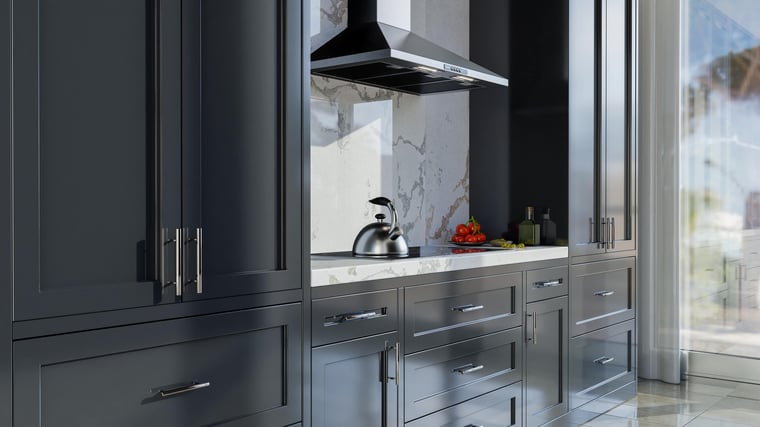
Pick the visible profile first, because that's the decision the client cares about. Then work through the rest: construction, center-panel material, finish responsibility, and how the profile behaves on the smallest fronts. Once every one of those is written down and approved, you have a specification a supplier can build to and a client can hold you to. Eagle Woodworking builds custom cabinet doors for your project to that kind of spec, Shaker or raised panel. When the profile is settled, our online ordering walks you through the rest.
Frequently Asked Questions
Are Shaker doors the same as recessed-panel doors?
A Shaker door is one kind of recessed-panel door. "Recessed panel" means the center panel sits back from the face of the surrounding frame. Shaker is the plainest version, with a square inside edge on the frame and a flat center. Other recessed-panel doors add a bead, bevel, or cove to the inside edge of the frame. Both are different from a slab door, which has no frame and no separate panel.
Can a Shaker frame have a raised center panel?
Often, yes. The frame profile and the center-panel profile are separate choices, so a square-edge Shaker frame can surround a raised center. In our naming system, that's still a Boston Shaker; you select the style and change the center panel. Our slim Bar Harbor frame is the exception and only takes a flat center. Other suppliers may name the combination differently, so describe both the frame and the center when you order.
Can Shaker and raised-panel doors be made with MDF?
Yes, both. A 5-piece wood door can carry an MDF center panel in either flat or raised form inside a hardwood frame. A 2-piece MDF door can also be flat or raised. A 1-piece MDF door, machined from a single blank, is flat only, and our slim Monroe and Bar Harbor styles are flat-center only regardless of material. MDF is a paint-grade material. It doesn't take stain like solid wood, and like any wood product it still responds to moisture, so it belongs in a dry interior with a proper finish.
Are raised-panel doors out of style?
No. Raised panels suit projects with profiled trim, traditional or formal rooms, and any job where the client wants visible detail. Shaker suits projects where the client wants clean lines. The right choice depends on the existing setting and the sample the client approves in the room, and the shape of the center panel by itself won't make a kitchen look dated or add to its resale value.
How should you compare Shaker and raised-panel door quotes?
Spec both doors identically except for the profile: same sizes, same construction (5-piece wood, 2-piece MDF, or 1-piece MDF), same center-panel material, same finish scope (unfinished, primed, or finished), and same hardware prep. Then compare the totals. If two quotes differ in any of those items, you're comparing two different products, and the profile name won't tell you which one should cost more.