
Despite rising material costs, labor shortages, and economic uncertainty, 77% of residential remodeling contractors say they're optimistic about the 2026 market — and 72% are raising their rates to match.
In February 2026, we surveyed 500 residential remodeling contractors and skilled tradespeople across the United States to better understand how professionals in the industry are approaching pricing, workload expectations, and homeowner demand heading into the year ahead.
The results reveal a market that remains busy but increasingly complex to operate in. Contractors report strong demand and growing workloads, but many are simultaneously preparing for higher costs, tighter labor availability, and ongoing pressure to justify pricing to homeowners.
The data highlights a central paradox shaping the 2026 remodeling market: demand appears resilient, but delivering that work is becoming more expensive and operationally challenging.
Across the survey results, five key patterns emerge — widespread rate increases, strong but uneven optimism across experience levels, a labor shortage that disproportionately impacts small businesses, a persistent gap between contractor pricing and homeowner expectations, and meaningful variation in rates and sentiment across regions and trades.
Together, these signals suggest that success in 2026 will depend less on demand and more on how effectively contractors manage costs, labor, and client expectations.
Executive Summary: 5 Signals Shaping the 2026 Remodeling Market
Survey responses highlight several structural shifts shaping the industry in 2026. Contractors expect steady demand, but rising costs, hiring challenges, and changing homeowner spending patterns are influencing pricing decisions, staffing strategies, and project selection.
Here are the five key signals that stand out in the data:
1. This Is a Margin Protection Market — Not a Pricing Power Market
While 72% of contractors plan to raise rates, only 18% cite increased demand as a reason. Material costs, inflation, and labor expenses dominate the drivers behind pricing adjustments. Rate increases are largely defensive — a move to protect profitability, not expand it.
2. Confidence Is High — but Experience Signals Caution
Overall optimism remains strong, with 77% of contractors reporting a positive outlook for 2026. However, contractors with 20+ years of experience are nearly three times more likely to express pessimism than mid-career professionals, suggesting that industry veterans may be reading potential economic risks differently.
3. Labor Constraints Are Reshaping Operations
Hiring skilled workers remains one of the industry’s most persistent challenges. Forty percent of small remodeling firms report serious hiring difficulty, nearly double the rate reported by larger companies. Labor shortages are influencing pricing, project timelines, and the number of jobs contractors are willing to take on.
4. The Homeowner Expectation Gap Is Widening
As contractors raise prices to keep pace with rising costs, many report increasing tension with homeowner expectations. A majority of contractors say homeowners underestimate the true cost of quality remodeling work, making clear communication around pricing and value more important than ever.
5. Demand Is Tilting Toward High-Impact, Phased Upgrades
Bathroom remodels and general repairs lead projected demand for 2026, while kitchen updates, cabinetry work, and incremental upgrades remain strong. Rather than committing to full-scale renovations, many homeowners appear to be investing in smaller, high-impact improvements that can be completed in phases.
What This Means for Contractors
The 2026 remodeling market is not slowing, but profitability will hinge on execution. Contractors who manage costs carefully, communicate value clearly, and optimize labor efficiency will be best positioned to convert strong demand into sustainable growth.
The Rate Hike Wave
72% of Remodeling Contractors Are Raising Their Rates for 2026 — Here's By How Much
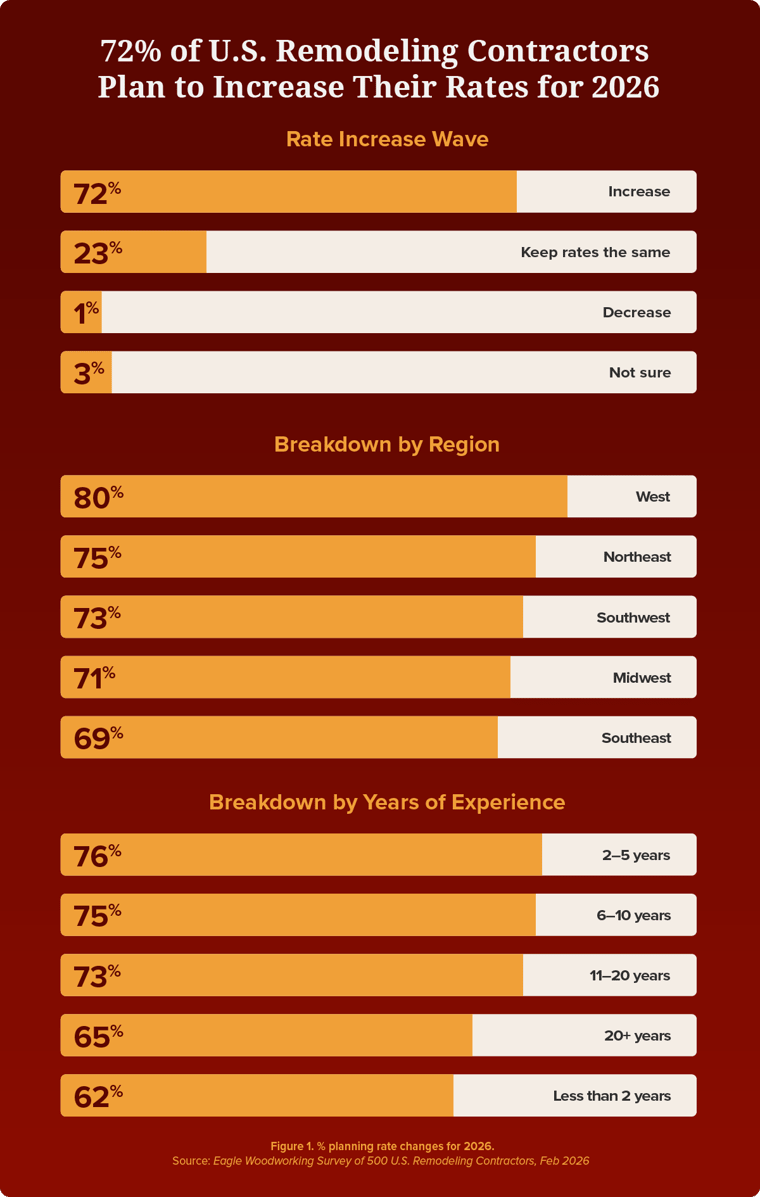
An overwhelming majority of contractors throughout the country — 72% — plan to increase their rates in 2026. Among those raising prices, 38% expect increases between 2% and 5%, while 18% plan to raise rates by 5% or more. Rate reductions will be rare, with just 1% of respondents saying they plan to lower their rates this year.
Rate increases are widespread across every region of the country. Contractors in the West report the highest share of planned increases, with 80% expecting to raise rates. The Northeast follows closely behind at 75%, while the Midwest and Southwest both sit above 70%. Even in the Southeast — the region reporting the lowest share of planned increases — 69% of contractors still expect to raise prices.
Experience level also appears to influence pricing strategy. Veteran contractors with more than 20 years in the industry are somewhat less likely to raise rates, with 62% planning increases, compared with 76% of contractors with two to five years of experience.
When asked what is driving these pricing adjustments, contractors pointed overwhelmingly to rising operating costs. The most frequently cited factors include:
- Rising material costs (64%)
- Keeping up with inflation (55%)
- Increased labor costs and paying workers more (47%)
- Higher fuel and transportation costs (37%)
- Insurance or licensing cost increases (24%)
- Investing in new tools or equipment (22%)
- Increased demand for services (18%)
Taken together, the data suggests that most contractors are raising rates to keep pace with costs rather than to capitalize on demand. Material prices, labor expenses, and inflation form the core pressures behind pricing decisions heading into 2026.
Because a strong majority of contractors in every region report planned increases, homeowners planning remodeling projects in 2026 should expect higher project costs across most markets.
Contractor Confidence Is Surprisingly High - But a Generational Gap Is Emerging
77% of Contractors Are Optimistic About 2026, But Industry Veterans Are More Cautious
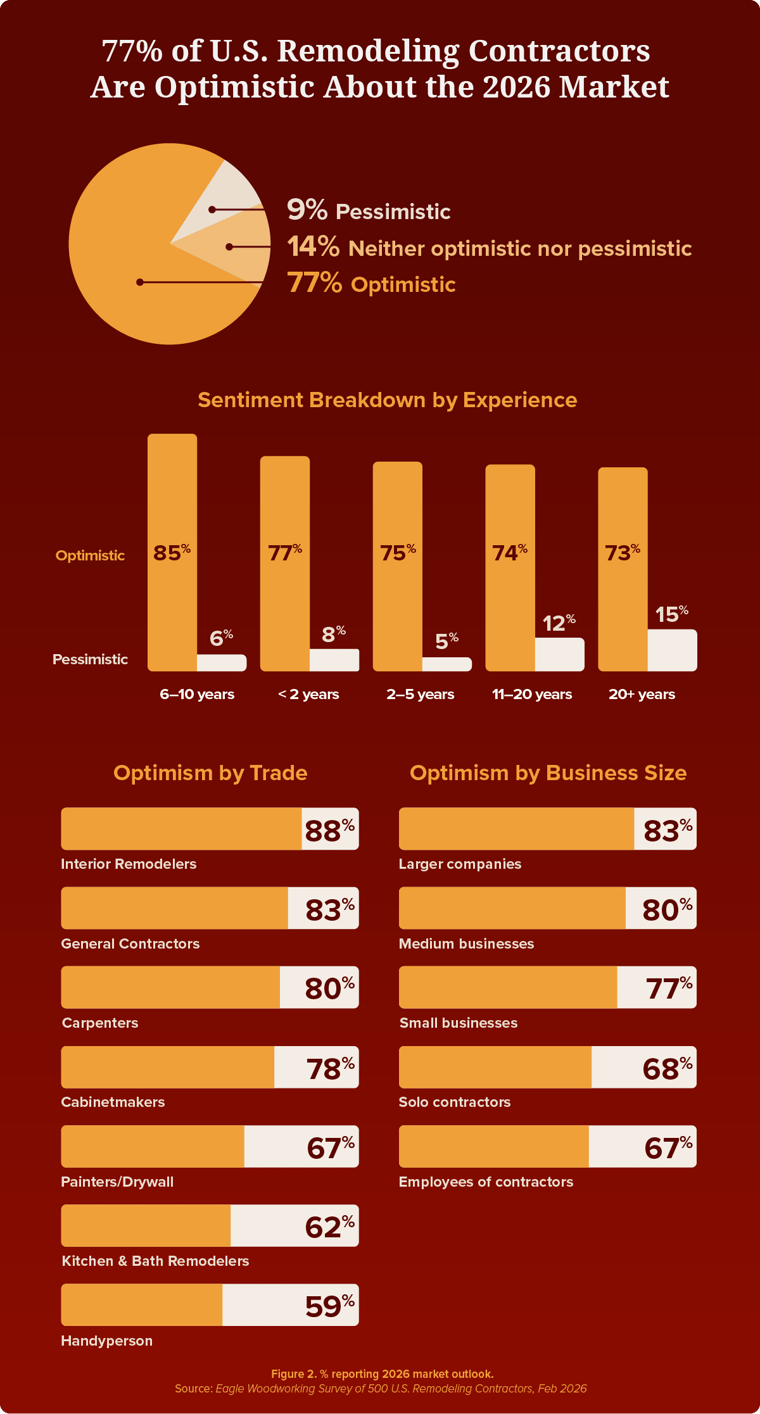
Despite rising costs and labor challenges, contractor sentiment heading into 2026 remains overwhelmingly positive. Seventy-seven percent of contractors report feeling optimistic about the year ahead, while only 9% say they feel pessimistic.
However, the data reveals a clear experience-driven gap in sentiment. Contractors with 20 or more years in the industry are more than twice as likely to report pessimism compared with mid-career professionals. Among veterans, 15% say they feel pessimistic about 2026, compared with just 6% of contractors with six to ten years of experience.
This difference likely reflects how experience shapes market expectations. Contractors who have lived through multiple cycles — including the 2008 housing crash, pandemic-era supply chain disruptions, and recent inflation spikes — may be reading current market signals more cautiously. Mid-career professionals, by contrast, have largely operated in a sustained growth environment and remain more confident about continued demand.
Sentiment also varies by trade. Kitchen and bath remodelers report the highest level of pessimism, with 23% expressing concern about the year ahead. In contrast, interior remodelers and general contractors report the strongest optimism, at 88% and 83% respectively. Carpenters (79%) and cabinetmakers (78%) also report strong confidence in the remodeling market.
Business size appears to influence outlook as well. Larger companies report higher optimism than solo contractors, likely reflecting stronger project pipelines, greater staffing capacity, and more financial cushion to weather cost fluctuations.
Taken together, the data suggests that while overall confidence in the remodeling market remains high, contractors with the most industry experience are signaling a more cautious outlook.
The Labor Squeeze Hits Small Businesses Hardest
40% of Small Remodeling Firms Say Hiring Skilled Workers Is Very or Extremely Difficult — Nearly Double the Rate of Larger Companies
Labor shortages remain one of the most persistent challenges facing the remodeling industry. Forty percent of small remodeling firms report that hiring skilled workers is very or extremely difficult, nearly double the 22% reported by larger companies.
This gap highlights a structural challenge for smaller contractors. Larger firms often have more resources to offer competitive wages, benefits, and steady work, making it easier for them to attract and retain experienced tradespeople.
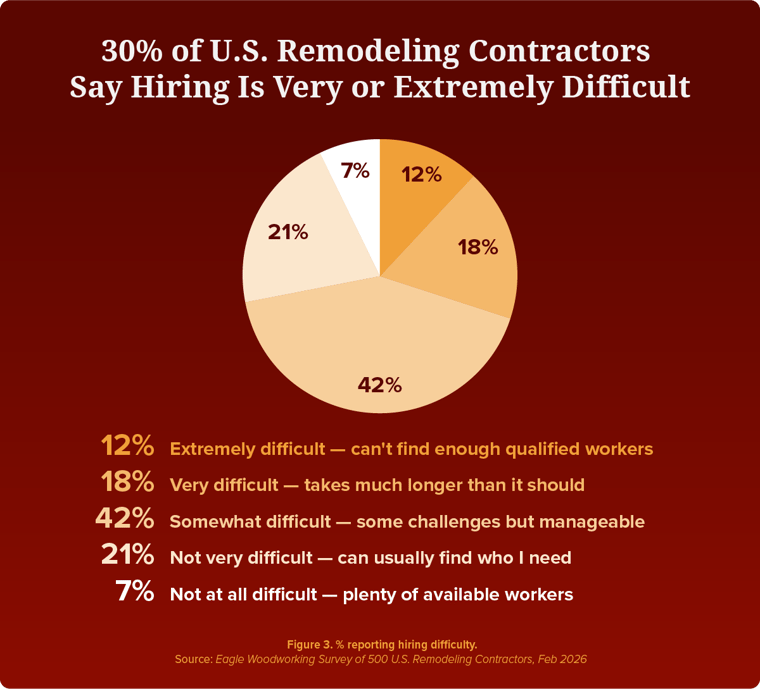
Across the industry as a whole, 72% of contractors report at least some difficulty hiring qualified workers. More than one-third of respondents (36%) also identified finding enough skilled labor as a major concern heading into 2026.
For smaller businesses in particular, labor shortages can have ripple effects. Limited staffing can lead to longer project timelines, turning down potential work, or relying on less experienced labor to fill gaps. In specialized trades such as custom cabinetry and finish carpentry — where precision skills are difficult to replace — the impact of the labor shortage may be even more pronounced.
The Homeowner Perception Gap - and Where It's Worst
77% of Kitchen & Bath Remodelers Say Homeowners Undervalue Their Work — The Highest of Any Trade
Contractors report a significant gap between the value they believe their work provides and homeowner expectations for remodeling projects.
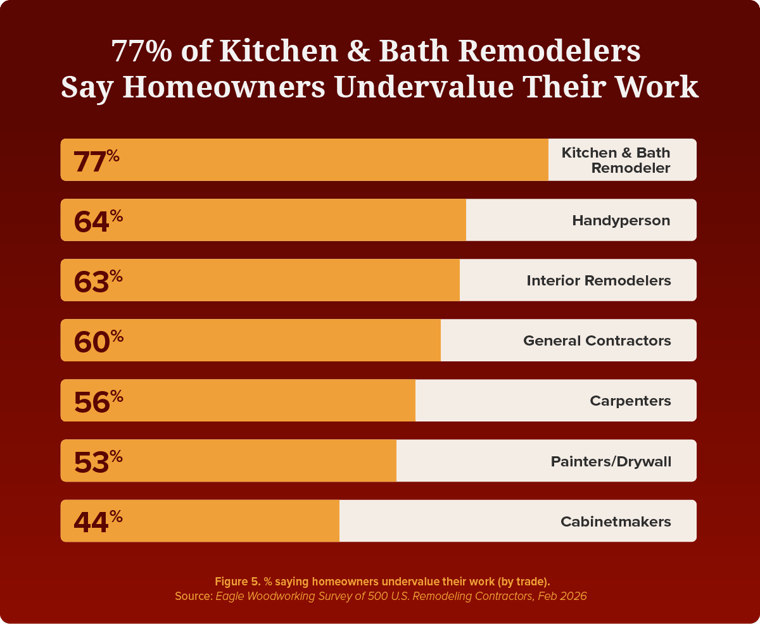
Kitchen and bath remodelers report the largest perception gap of any trade in our survey, with 77% saying homeowners undervalue their work. Handypersons (64%), interior remodelers (63%), and general contractors (60%) also report high levels of perceived undervaluation.
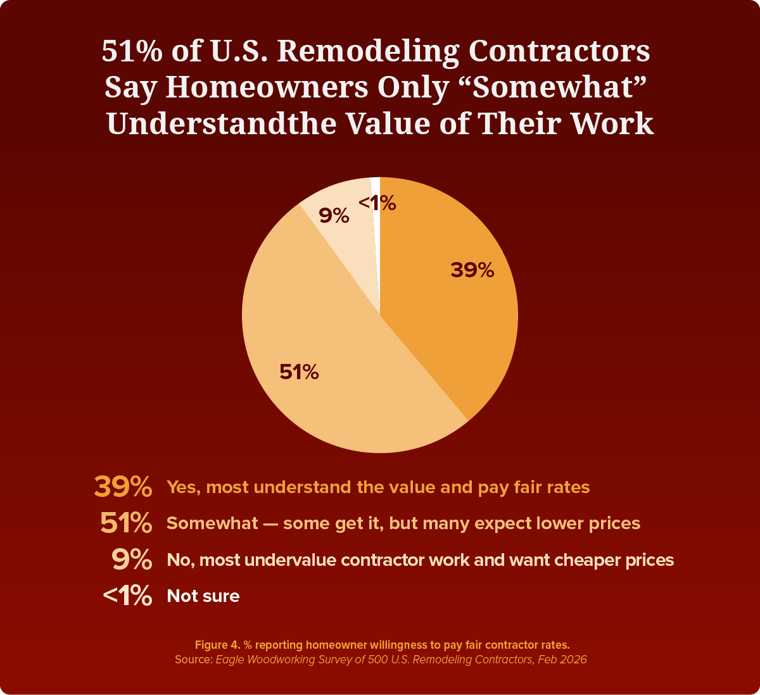
The broader data suggests this disconnect extends across the remodeling industry. In our survey, 51% of remodeling contractors say homeowners only “somewhat” understand the value of their work, while 9% say homeowners largely undervalue contractor services and want cheaper prices. Only 39% believe most homeowners fully understand the value of quality remodeling work and are willing to pay fair rates.
At the other end of the spectrum, cabinetmakers report the lowest share of respondents who feel undervalued (44%). One possible explanation for this perception is the visibility of the finished product. Work such as custom cabinetry, finish carpentry, and detailed millwork produces tangible results that homeowners can immediately see and evaluate. By contrast, contractors managing full remodels often perform significant planning, coordination, and project management work that may be less visible to clients.
Where the Demand Is - Project Projections for 2026
Bathroom Remodels and General Repairs Top Contractor Demand Projections, but Kitchen Work Remains Strong
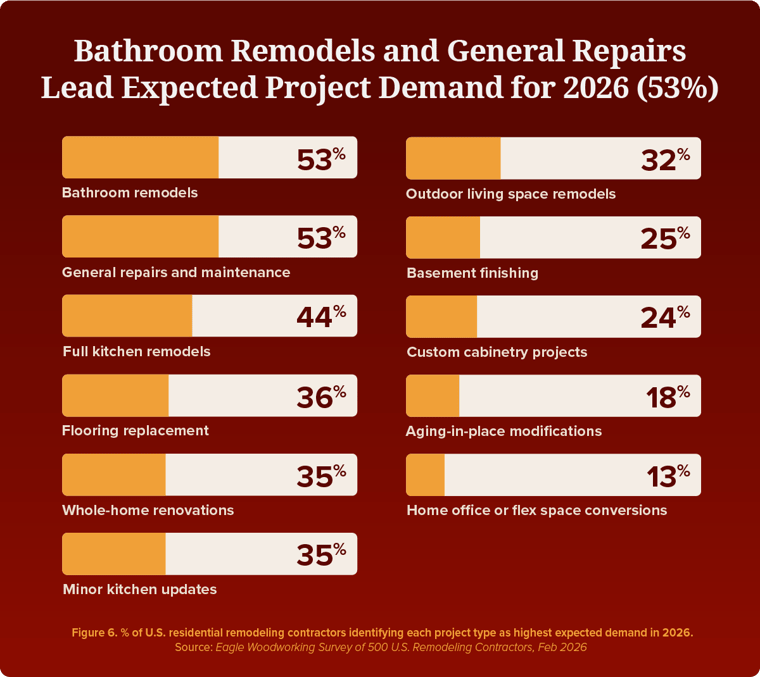
Contractors expect bathroom remodels and general repairs/maintenance to generate the most demand in 2026, with 53% of respondents selecting each category. Full kitchen remodels follow closely at 44%.Other commonly cited projects include flooring replacement (36%), minor kitchen updates such as cabinet refacing and countertop replacements (35%), and whole-home renovations (35%).
Taken together, the data shows that kitchen and bathroom projects continue to dominate remodeling demand. When full kitchen remodels, minor kitchen upgrades, and custom cabinetry work are considered together, kitchen-related projects represent a substantial share of expected activity in the year ahead.
The data also suggests a shift in how homeowners approach renovation spending. Rather than committing to full-scale remodels, many homeowners appear to be prioritizing smaller, high-impact improvements that can be completed in phases.
For contractors working in kitchens, bathrooms, and custom cabinetry, this trend highlights the growing importance of targeted upgrades such as cabinet refacing, drawer replacements, and hardware updates. These projects allow homeowners to refresh key spaces while managing budgets and project timelines more carefully.
What the 2026 Remodeling Market Means for Contractors
The 2026 remodeling market is shaped by a clear tension: contractors expect strong demand and busier workloads, but rising costs are forcing many to increase prices. Nearly three-quarters of contractors surveyed plan to raise their rates this year, even as many report ongoing challenges aligning homeowner expectations with the true cost of remodeling work.
Several patterns stand out heading into 2026:
- Nearly five times more contractors expect workload increases than decreases.
- 72% plan to raise rates, compared with just 1% planning to lower them.
- Labor shortages affect small businesses at nearly double the rate of larger firms.
- Industry veterans report more caution than mid-career contractors, likely reflecting experience with past market cycles.
- Kitchen and bath remodelers report the highest levels of pessimism and the largest homeowner value gaps.
- Cabinetmakers report the strongest homeowner appreciation and remain part of one of the highest-demand project categories.
Overall, contractor sentiment remains positive heading into 2026. For kitchen projects in particular, high-quality cabinetry and visible craftsmanship continue to play an important role in homeowner satisfaction, even as contractors work to align expectations around pricing and project scope.
For contractors, the takeaway is clear: strong demand alone will not guarantee profitability. Those who benchmark pricing carefully, communicate value clearly, and plan for ongoing labor constraints will be best positioned to succeed in the year ahead.
Survey Details
Survey Details:
- Data source: Pollfish survey platform
- Total sample size: 500 residential remodeling contractors and skilled tradespeople
- Screening criteria: All respondents confirmed they work as a contractor or skilled tradesperson in the residential home remodeling, renovation, or repair industry. Respondents who selected "primarily new home construction" or "primarily commercial construction" were filtered out.
- Collection period: February 2026
Sample Composition by Trade:
-
General contractor / remodeling contractor: 60.6% (303 respondents)
-
Handyman / general home improvement: 11.2% (56 respondents)
-
Painter / drywall specialist: 9.0% (45 respondents)
-
Carpenter / finish carpenter: 6.8% (34 respondents)
-
Interior remodeling specialist: 3.2% (16 respondents)
-
Kitchen & bath remodeler: 2.6% (13 respondents)
- Cabinetmaker / custom cabinet installer: 1.8% (9 respondents)
- Other trades (flooring, tile, countertop, trim, other): 4.8% (24 respondents)
Sample Composition by Region:
-
Southeast: 32.0% (160 respondents)
-
Midwest: 22.4% (112 respondents)
-
Northeast: 19.6% (98 respondents)
-
Southwest: 14.2% (71 respondents)
-
West: 11.8% (59 respondents)
Sample Composition by Experience:
-
11–20 years: 32.4% (162 respondents)
-
6–10 years: 27.4% (137 respondents)
-
2–5 years: 19.2% (96 respondents)
-
More than 20 years: 18.4% (92 respondents)
-
Less than 2 years: 2.6% (13 respondents)
Sample Composition by Business Size:
-
Small business (2–5 employees): 31.8% (159 respondents)
-
Medium business (6–20 employees): 31.2% (156 respondents)
-
Larger company (21+ employees): 16.4% (82 respondents)
-
Solo contractor: 15.2% (76 respondents)
-
Employee of a contractor/company: 5.4% (27 respondents)