

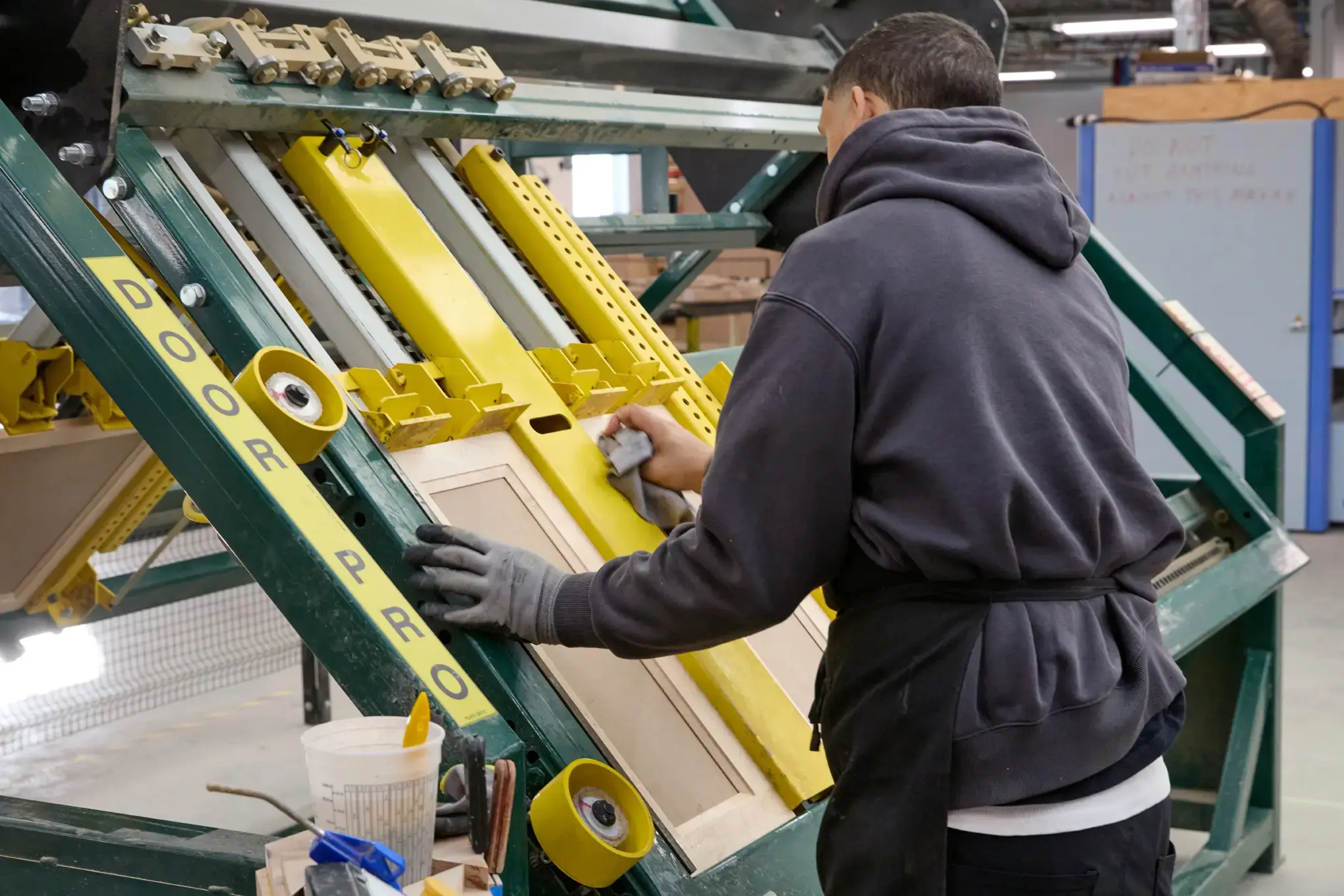
Nearly half of small cabinetry, carpentry, and remodeling businesses now pay an outside supplier to build their cabinet doors, a larger share than for any other task in the shop or the office.
In September 2026, we surveyed 285 owners and co-owners of small trade businesses across the United States, all running shops with 20 or fewer people. We asked what they pay someone else to do, what they used to build themselves, what they would never hand off, and how many hours a week they lose to work no customer pays for.
Thirty-six percent of owners say doors are work they once built in-house and now buy. Among owners who moved door production out of the shop, the top reason they gave for outsourcing was more work than they could build.
Executive Summary: 4 Signals From the Make-vs-Buy Data
1. Cabinet Doors Lead Every Outsourced Task
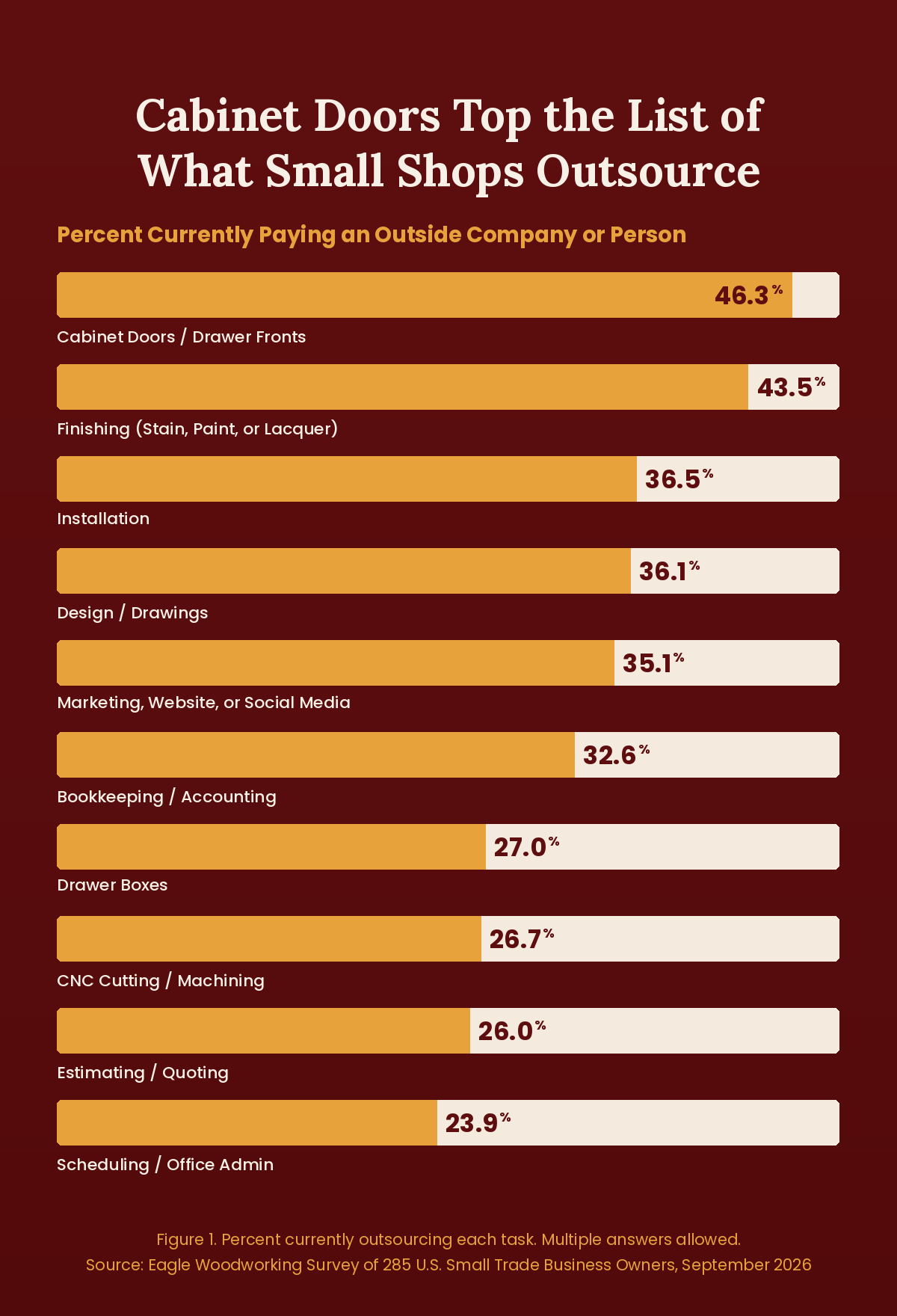
At 46%, doors and drawer fronts top the list of work small shops pay someone else to do, ahead of finishing (44%), installation (37%), and every office function we asked about, including bookkeeping, estimating, scheduling, and marketing.
2. Shops Buy Doors When Demand Outruns the Shop Floor
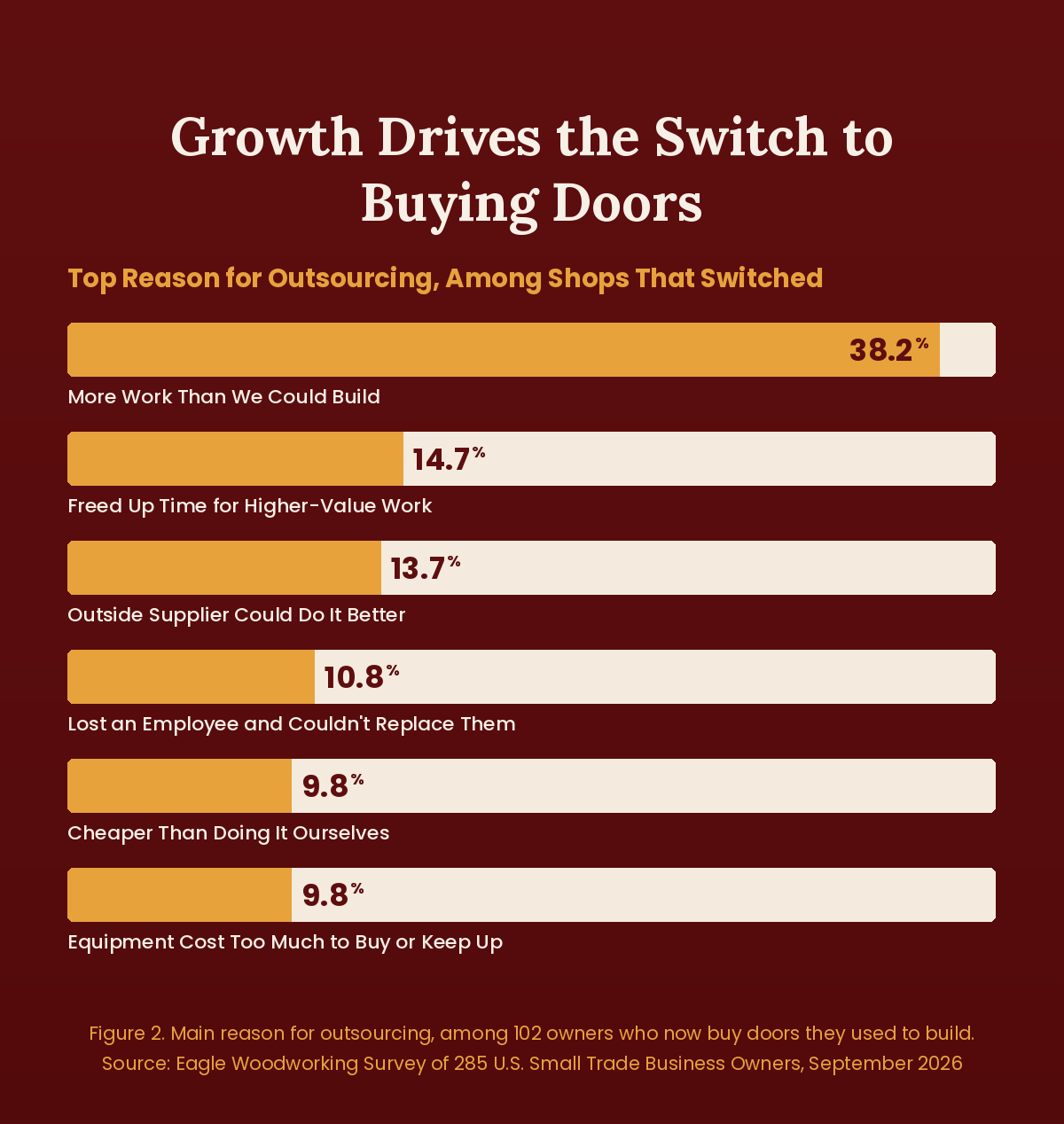
Among owners who switched from building doors to buying them, 38% said the main reason they outsourced was more work than they could build. Only 10% said it was cheaper. Door buying is also more common in larger shops, and door buyers are more likely to be planning new hires.
3. Proof of Quality Matters as Much as Price
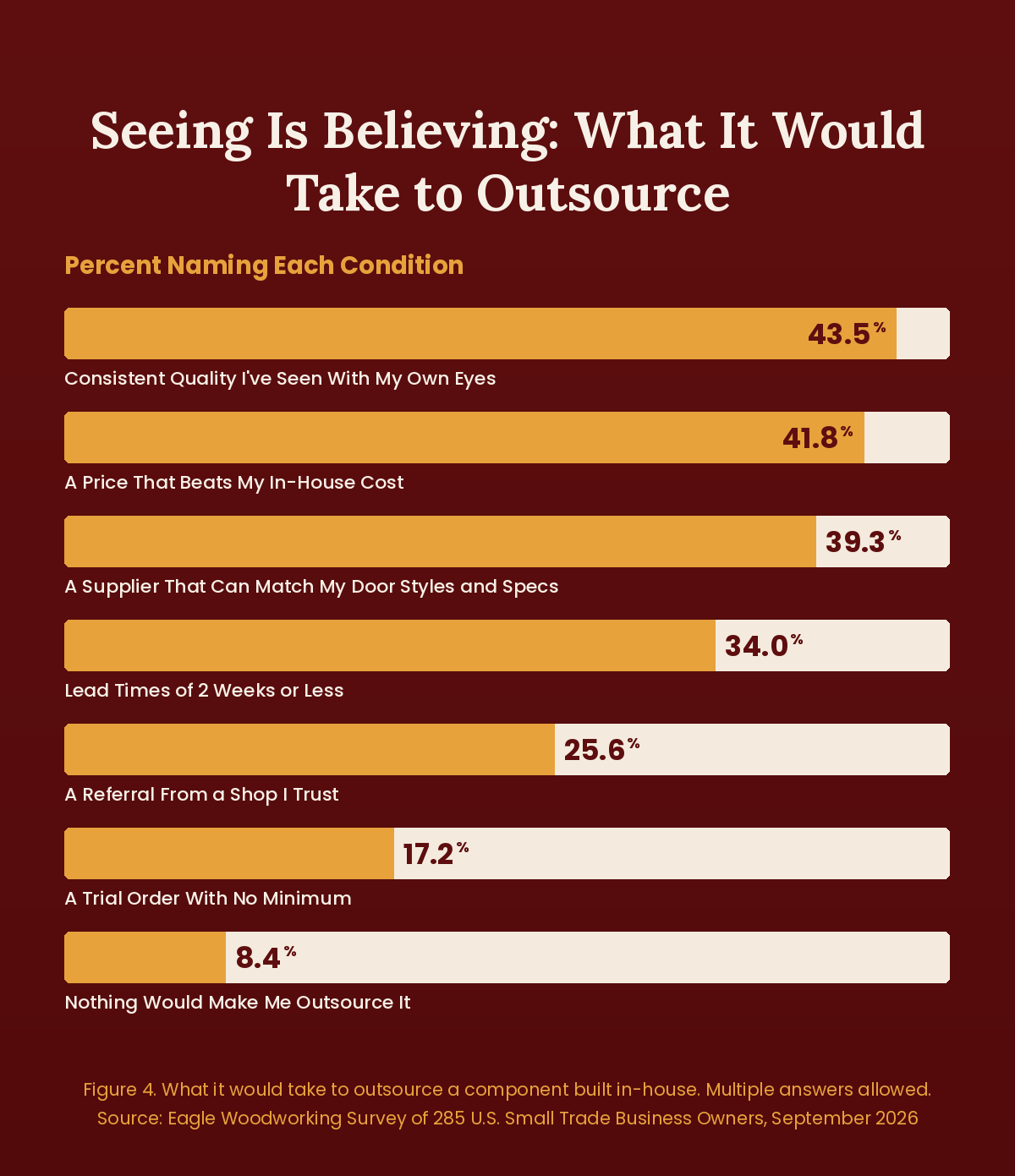
When we asked owners what it would take to outsource a component they build today, the top answer was consistent quality they have seen in person (44%), just ahead of a better price (42%). Spec matching (39%) and lead times of two weeks or less (34%) followed.
4. The Paperwork Happens After Hours
Owners spend an estimated 16.6 hours a week on work they can't bill, and 60% do most of it early in the morning, in the evening, or on weekends. Given 10 hours back, most would spend them on more jobs or more time on the shop floor.
What This Means for Shop Owners
Buying doors is a growth move for small shops, and only 8% of owners say nothing would get them to outsource a component they build today.
The Door Is Where Outsourcing Starts
46% of Small Shops Now Buy Their Cabinet Doors, the Most Outsourced Task in the Business
We gave owners a list of ten tasks that a small trade business can either handle in-house or pay someone else to do. Cabinet doors and drawer fronts came out on top: 46% of owners (132 of 285) currently buy them from an outside company or person.
Finishing ran a close second at 44%. Below that, installation, design and drawings, and marketing each landed between 35% and 37%, with bookkeeping just behind at 33%. Estimating and scheduling sat near the bottom at 26% and 24%.
Doors are repetitive, spec-driven work that eats bench hours and machine time. Buying them in gives those hours back to casework, fitting, and installation.
Door buying runs highest in the trades closest to cabinetry. Fifty-six percent of cabinetry, millwork, and custom furniture shops buy their doors, and so do 61% of finish carpentry and trim businesses, though that second group is small at 28 owners. General carpenters came in at 48%, and remodelers and general contractors at 36%.
More than a third of owners (36%, or 102 respondents) told us doors and drawer fronts are work they used to build themselves and now buy. Only finishing (36.1%, just ahead of doors at 35.8%) and bookkeeping (34.7%) have been moved out of the shop as often.
Drawer boxes sit further down the list, with 27% of owners buying drawer boxes built to their specs from an outside shop.
Nearly nine in ten owners pay someone else for at least part of the job; just 11% said they do everything in-house.
Growth Drives the Switch to Buying Doors
Shops Stop Building Their Own Doors When They Have More Work Than They Can Build
Among the 102 owners who moved door production to an outside supplier, the most common reason for outsourcing was more work than they could build, cited by 38%. Freeing up time for higher-value work came next at 15%, followed by an outside supplier doing it better at 14%. Saving money ranked fifth, at 10%, tied with the cost of buying or maintaining equipment.
Our look at how outsourcing cabinet components affects profitability covers the margin side of that decision.
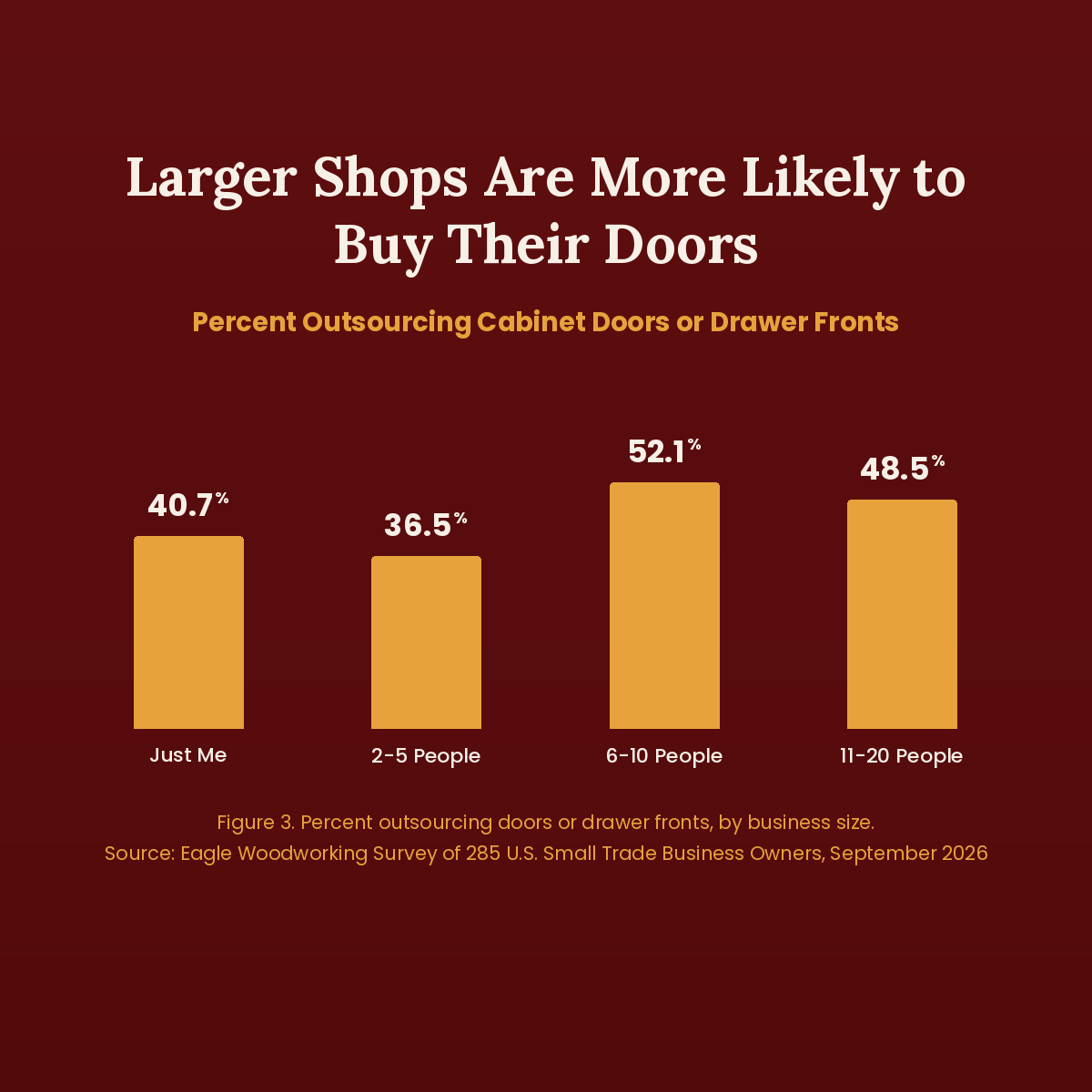
Door buying is also more common in larger shops: about half of businesses with 6 to 20 people buy their doors (52.1% of shops with 6 to 10 people and 48.5% of shops with 11 to 20). Among shops with 2 to 5 people, the share drops to 37%. Solo operators came in at 41%, though with only 27 respondents in that group, the number is best read as a rough indicator.
Owners who buy their doors are more likely to be planning growth: 45% of them plan to hire more people in the next 12 months, compared with 37% of owners who build their own.
What It Takes to Win the Holdouts
Seeing Consistent Quality Ranks Ahead of a Lower Price for Shops Still Building In-House
When we asked owners what they would never outsource, finishing (40%) and cabinet doors (39%) topped the list, the same two items that top the list of what shops already buy. Doors split small shops almost evenly between buyers and builders.
Asked for the biggest reason they keep that work in-house, owners most often named distrust of anyone else's quality (22%), followed closely by customers who expect the work to come from the shop itself (20%). Enjoying the work came third at 16%. Supplier cost (9%) and slow outside lead times (3%) ranked near the bottom of the list.
Quality came up again when we asked what would change their minds. Only 8% of owners said nothing would make them outsource a component they build today. For everyone else, the top conditions were:
- Consistent quality they have seen with their own eyes (44%)
- A price that beats their in-house cost (42%)
- A supplier that can match their door styles and specs (39%)
- Lead times of two weeks or less (34%)
A referral from a shop they trust (26%) and a trial order with no minimum (17%) rounded out the list.
Price came a close second, but three of the top four conditions are about what shows up on the job: whether the doors match what the shop already builds, whether they're consistent from one order to the next, and whether they arrive in time to keep the schedule. A supplier that publishes its specs and tolerances and takes small orders with no minimum lets a skeptical owner judge the work before committing to it.
The Hours Nobody Pays For
Small Shop Owners Lose an Estimated 16.6 Hours a Week to Unbillable Work, Mostly Before or After the Workday
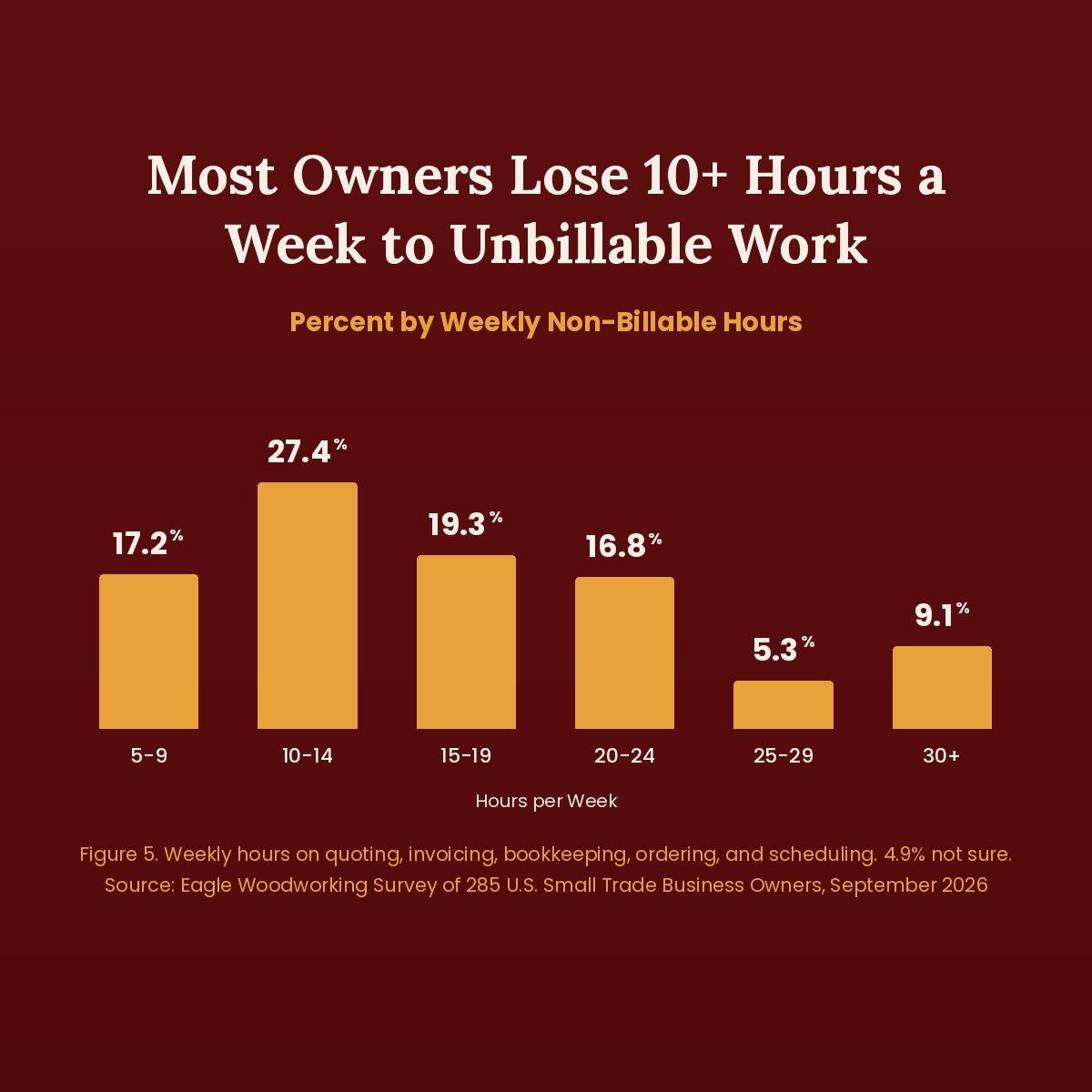
The survey also asked owners to add up the hours they personally spend each week on quoting, invoicing, bookkeeping, ordering materials, scheduling, chasing payments, and marketing.
The most common answer was 10 to 14 hours, chosen by 27% of owners. Another 19% put their week at 15 to 19 hours, and 31% said 20 hours or more. Nine percent reported 30 hours or more, close to a second job on top of running the shop. Averaged across the brackets, owners spend an estimated 16.6 hours a week on unbillable work.
Owners of the largest shops carry the heaviest load: an estimated 18.4 hours a week for 11- to 20-person shops, compared with 14.8 for shops with 2 to 5 people. Owners who buy their doors also put in more of these hours (about 17.7 a week) than owners who build their own (about 15.7).
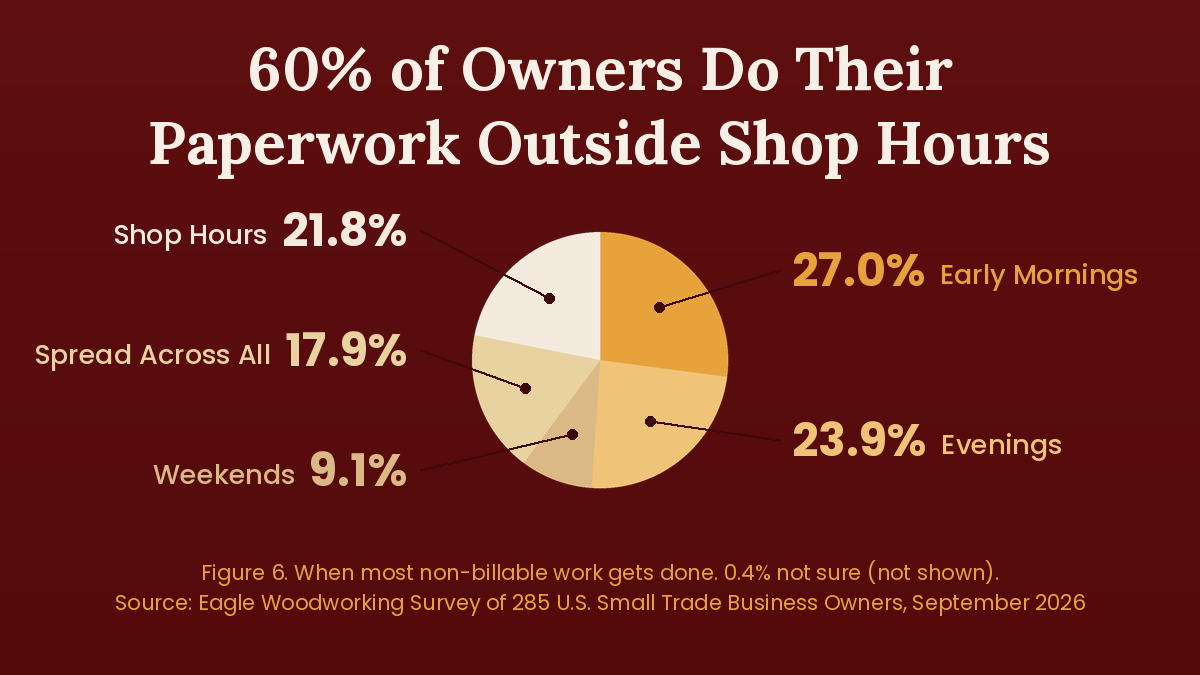
Twenty-seven percent said most of their paperwork gets done early in the morning before the crew arrives, 24% said evenings after the shop closes, and 9% said weekends. In total, 60% of owners do most of their unbillable work outside normal shop hours. Only 22% handle it during the workday.
Bookkeeping and taxes (22%) and invoicing and chasing payments (21%) were the tasks owners most often named as their single largest time sink, followed by quoting and estimating (19%). Between them, bookkeeping and invoicing are the biggest time sink for 43% of owners.
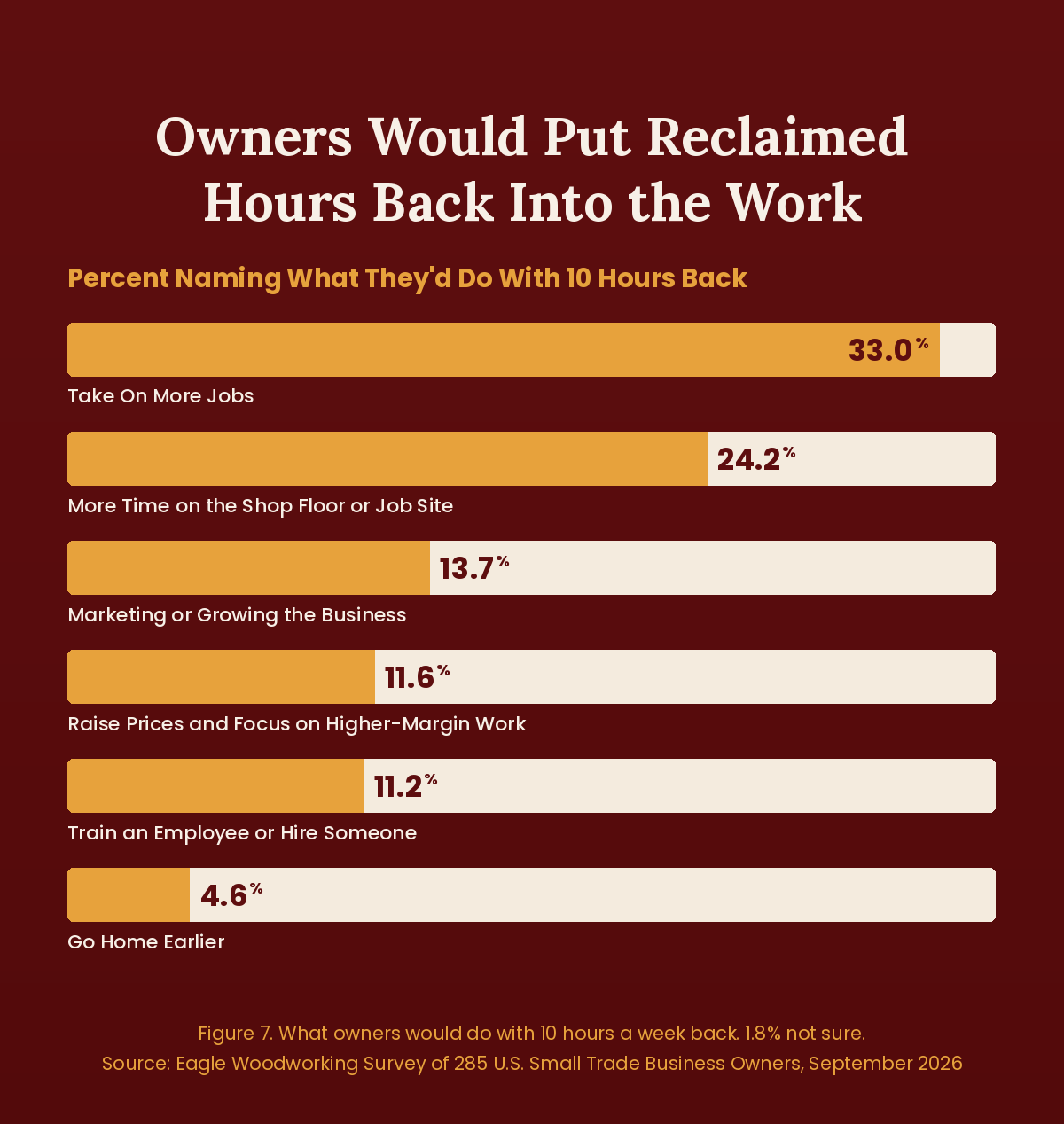
Given 10 of those hours back, most owners would put them into production. A third (33%) would take on more jobs, and another 24% would spend more time on the shop floor or job site. Marketing and growth (14%), raising prices to focus on higher-margin work (12%), and training or hiring (11%) followed. Just 5% said they would go home earlier.
Over the next 12 months, 35% plan to outsource more office and admin work, 34% plan to adopt new software, and 41% plan to hire. Those hires will be hard to make: in our 2026 contractor outlook and pay report, 40% of small remodeling firms said hiring skilled workers was very or extremely difficult.
What the Make-vs-Buy Data Means for Small Shops
Across 285 small trade businesses, cabinet doors are the task owners outsource most. The top reason shops gave for making the switch was orders that outpaced the shop, and the businesses that buy their doors are larger and more likely to be hiring.
For owners weighing the decision, the math covers more than the price per door: it includes the bench hours, the machine time, and the jobs a full shop has to turn down or push back. Comparing that full cost against ordering custom cabinet doors built to your specs, and testing a supplier with a small order before committing, is the most direct way to find out which side of the make-vs-buy line your shop belongs on.
Survey Details
Survey Details:
- Data source: Pollfish survey platform
- Total sample size: 285 owners and co-owners of U.S. trade businesses
- Screening criteria: All respondents confirmed they own or co-own a business whose primary trade is cabinetry, millwork, custom furniture, finish carpentry, general carpentry, or general remodeling and contracting, with 1 to 20 people including the owner.
- Collection period: September 16-22, 2026
- Notes: Figures are unweighted. Percentages for questions that allowed multiple answers sum to more than 100%. The weekly-hours average is estimated from the midpoints of bracketed answers and excludes the 4.9% of owners who were not sure. The reason for outsourcing among door switchers reflects each owner's main reason for outsourcing overall.
Sample Composition by Trade:
- General remodeling or general contracting: 38.2% (109 respondents)
- General carpentry: 30.5% (87 respondents)
- Cabinetry, millwork, or custom furniture: 21.4% (61 respondents)
- Finish carpentry or trim work: 9.8% (28 respondents)
Sample Composition by Business Size (Including Owner):
- Just me: 9.5% (27 respondents)
- 2-5 people: 22.1% (63 respondents)
- 6-10 people: 33.0% (94 respondents)
- 11-20 people: 35.4% (101 respondents)
Sample Composition by Years in Business:
- Less than 2 years: 4.2% (12 respondents)
- 2-5 years: 28.4% (81 respondents)
- 6-10 years: 40.4% (115 respondents)
- 11-20 years: 21.8% (62 respondents)
- More than 20 years: 5.3% (15 respondents)